A Light for One Window
Page 50 of 225
Chapters
Tamsin let the silence after that answer remain. The recorder’s reels continued turning. Through the pane, a working berth stayed lit while the neighboring houses dimmed one by one. She did not ask Orla to describe the night her brother was lost. That was not the question, and the recorder did not own the space just because it was running.
Orla glanced toward the machine. “Are you still there?”
“Yes.”
“Good. I don’t want you to trim the leaving out. I’m not ashamed of it.”
Tamsin marked the moment on her note sheet. “I won’t.”
“I did not say the lamps started for people like me,” Orla added. “I said what the interval gave me.”
Tamsin nodded. That sentence would have to stay attached to the first. “I understand.”
“Do you?” Orla asked, not sharply. “Then you know the answer can’t be made to serve as the founding story.”
Tamsin watched the red latch. “Yes.”
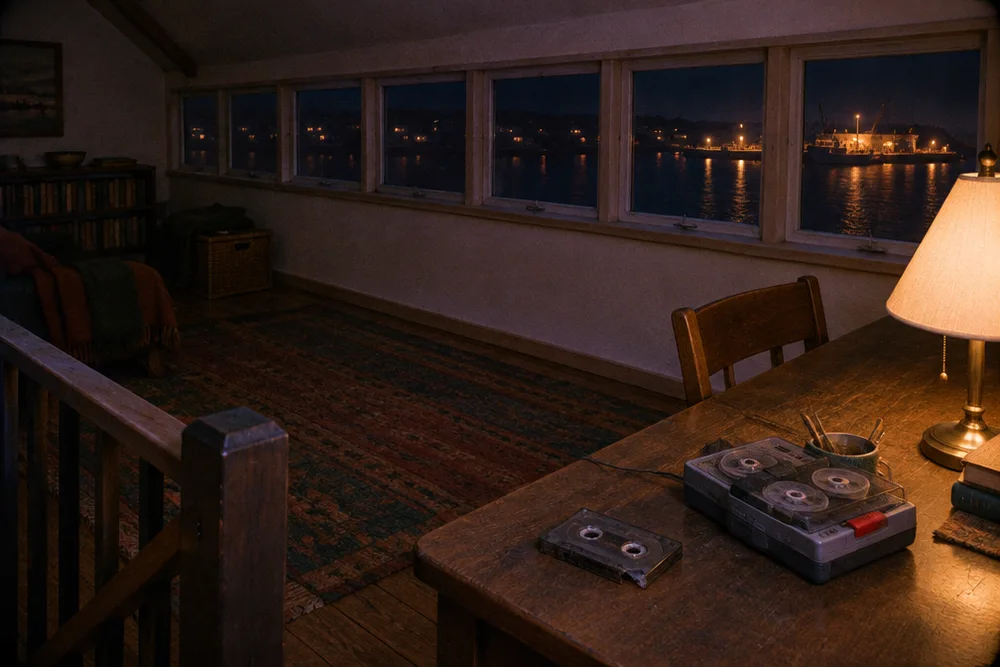
Orla asked Tamsin to stop the recorder. The click sounded small in the loft, swallowed almost at once by the harbor’s muted evening noise.
“I don’t want the account used to make the memorial sound like an invention,” Orla said. “The older lamps don’t cancel the people named later.”
“I won’t make them cancel each other.” Tamsin wrote that down, then crossed it out. It was a promise, not a fact. She tried again: Orla says the earlier lamps and later memorial served different needs; she does not treat either as a substitute for the other.
Orla leaned over the notebook. “That’s fair.”
“I’m trying to work out what I can say in the narration. The committee wants a clean history. The minutes give me a timed trial, but not a reason. The program gives me a memorial, but it doesn’t prove the vigil started there.”
“Then say that.”
“It won’t sound like a beginning.”
“Maybe there isn’t one beginning in the records.” Orla drew the minute book closer and pressed its cover flat. “People have a way of turning a sequence into a founder. One person lights a lamp; someone else joins; then a committee prints a program. Later, a child wants a sentence short enough to memorize, and the lamps become one thing that started on one date.”
Tamsin thought of Nell Shawdrift’s cassette, still out of the school booth and with Wystan. Nell’s story supplied an earlier sequence of favors, but not dates she could swear to. The photograph showed six windows, but it could not say who the lamps were for. Now the minute books offered an interval set to a bell keeper’s walk, and a program that made space for waiting as well as loss.