A Light for One Window
Chapter 15 · The Unrecorded Chair
Page 161 of 225
Chapters
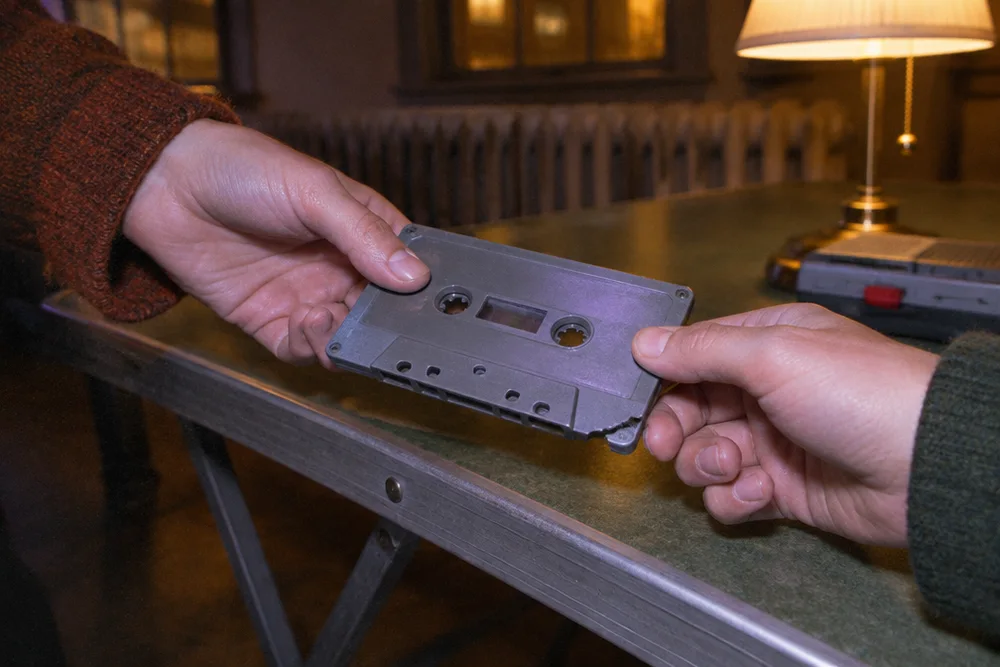
The Net Exchange had been warm when the last person spoke, but now the radiator knocked and the room seemed to have grown larger around the chairs. Tamsin sat at the folding table with her gray recorder, red latch shut, and the little stack of permission slips arranged in a row. Some were signed. Some had boxes ticked beside particular sentences. One had a thick line through the whole page. The cassette player sat beside her, its smoke-gray shell chipped at the lower corner. She had thought the hard part would be getting people to talk. She had not thought the hard part would be keeping the things they said from becoming hers.
A woman in a green headscarf stood near the door with her husband and a boy who kept turning the paper cup in his hands. Tamsin remembered their contribution: the woman’s father, waiting for a boat that never came in on time, standing at the harbor window with his coat on. She had told it steadily, then laughed once at the end, as if the laugh could pack the memory away. The family had listened to Tamsin’s rough playback. Now the woman’s face was tight with decision. “I don’t want that part kept,” she said. “Not for the archive. Not even the bit about the coat.”
“You can take it back,” Tamsin said. She did not reach for the recorder. “I’ll give you the only copy.”
The woman looked at the machine, then at Tamsin. “You’ve already made a copy?”
“No. This is the only one. I haven’t duplicated anything.” Tamsin heard how quickly she answered, the way she did when she wanted a fact to stay clean. “I can hand it over now.”
The husband glanced toward the boy, whose cup had gone soft at the rim. “It’s not that we’re ashamed of him,” he said. “It’s that everyone here knows which boat, and everyone knows what happened after. We came to listen, not to have it put somewhere people can borrow it.”
Tamsin nodded. She had written that their permission covered the public reading and the recording. She had thought of the recording as a route to a future archive, not a thing with a weight that could come back on the family. The paper had not made the distinction clear enough. “I should have asked separately,” she said. There was no useful way to add that she had not known how much the distinction mattered until now.