A Light for One Window
Page 139 of 225
Chapters
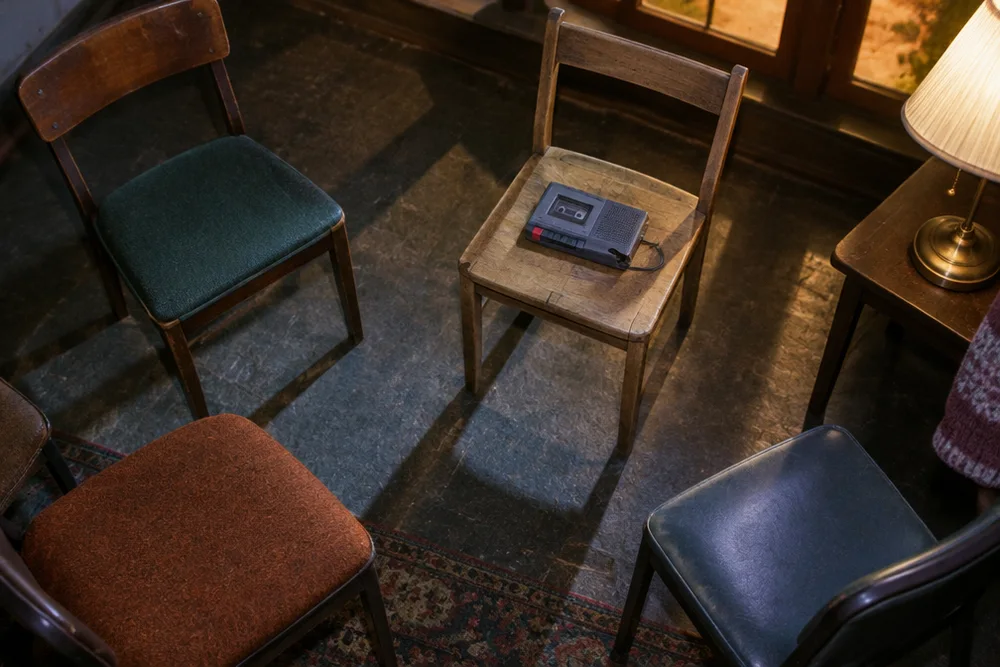
“And if you’re the one running it?” Nell asked.
“Then you can shout at me.”
Nell looked from him to Tamsin. “I’m not shouting at either of you. I’m stopping the tape.”
“Right,” Tamsin said. She took her hands off the machine and sat in the empty chair opposite Nell. The space between them felt deliberately plain, with no notebook open on Tamsin’s knee and no microphone between their faces.
Nell tested the stop key. It clicked down with a firm plastic sound. She pressed play, listened to a few seconds of nothing but tape hiss, then stopped it again.
“That’s all?”
“That’s all,” Tamsin said.
“Good. Don’t make a speech when I do it.”
Tamsin felt the sentence land and held still rather than smoothing it over. “I won’t.”
They had come to rehearse the stop, not the excerpt. Tamsin understood that distinction and still felt the itch to fill the quiet with instructions. She had a list of practical matters in her coat pocket: chair spacing, the transcript’s large type, the order of speakers, the place to put the water jug. Every item had a neat line beside it. Nothing on the list said what she should do if Nell stopped the tape and sat with the room looking at her.
“Would you like to try it with the excerpt?” Tamsin asked. “Only if you want to.”
Nell’s eyes narrowed. “You’ve said that twice now.”
“I’ll stop saying it.”
“Good.” Nell turned the player toward herself. “I don’t need practice hearing my own voice. I know what it sounds like.”
“Then we can practice what happens after.”
“What happens after is people waiting. That’s the part you can practice.”
Tamsin looked at the chair circle. The people who would come on the night were not here yet, but their attention seemed already arranged in the empty seats. Some would have heard the teaser. Some had reasons to trust the vigil and reasons to doubt the plaque. Some might arrive expecting a verdict. Tamsin could write prompts and set out chairs; she could not keep anybody from waiting for Nell to explain herself.
She stood and moved the nearest chair another handspan away from the player. “If people start looking at you, they can look at me instead.”
“No,” Nell said. “They can look at the tape machine. It’s the thing they came to hear.”
Tamsin left the chair where it was. Nell had not asked her to defend her, and the offer had been another way of taking over the moment. The lesson was uncomfortable in a small, useful way: making space did not mean choosing where everyone looked.