A Light for One Window
Page 101 of 225
Chapters
Orla held out the key. Tamsin did not take it. “You can keep it for now,” Orla said. “The loft is booked until the end of the week.”
The key rested between them, blue string looped around its head. Tamsin could still choose the approved narration. It would be eligible. It would be the version that got her the window, and the course money that came with it.
The committee gathered its folders. Mr. Pell paused by Tamsin on his way to the stair. “You’ve done careful work,” he said. “Don’t mistake a disagreement about framing for a judgment on your ability.”
Tamsin thanked him. She meant it, partly. She also knew praise could be a way of asking someone to accept the boundary without making a fuss.
At the door, Orla stopped beside her. “The names on the register will still be read at the second bell. The lamp will still go on. The families aren’t asking you to erase the other beginning.”
“I don’t want to erase the names.”
“I know.” Orla’s heel-first walk sounded down the stair. “That’s why this is hard.”
When the loft was empty, Tamsin opened her notebook to the page where she had compared the two accounts. She crossed out a line she had written earlier: Nell’s tape contradicts the official history. Under it she wrote: Nell’s tape unsettles the claim of a single beginning; it cannot date the lamps. Then she added: Orla’s memory explains the ritual’s use, not its first use.
The words were less satisfying than a verdict. They were also more accurate.
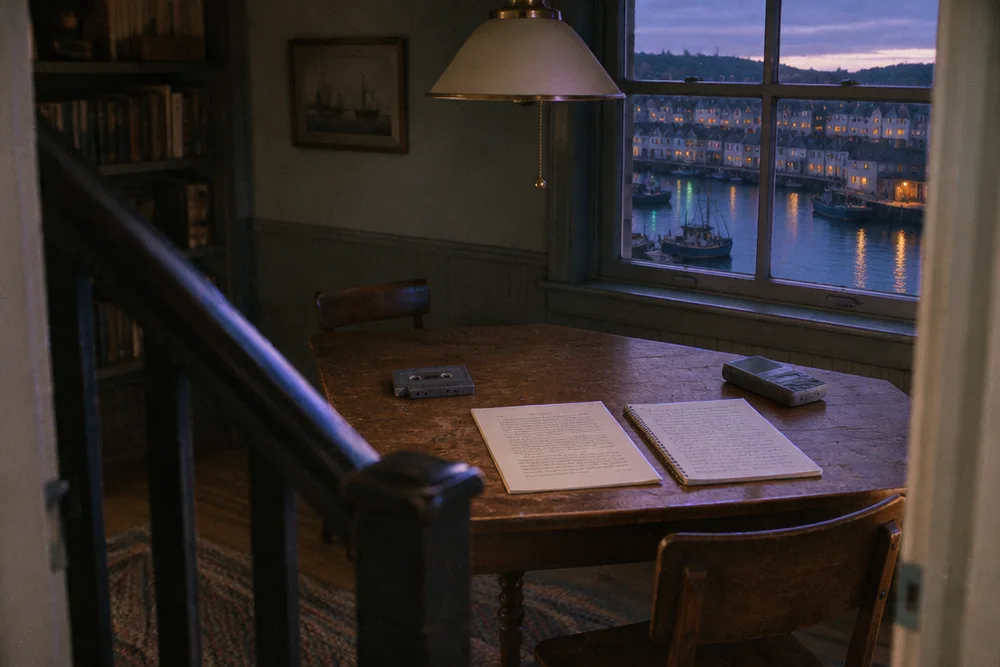
She packed the notes, leaving the approved narration on the table. The unlit lamp sat above the paper, the brass pull ending just short of the cream shade. From the landing she could see the basin below, houses shoulder to shoulder along the inner harbor, each window facing the water. Some would darken on vigil night; some would not. Navigation lights would remain. Working berths would remain. The Stitch Room would hold its single amber pane when the first bell sounded.
Tamsin understood why Orla wanted the ceremony protected. She understood why Wystan would not lend the tape again for a version that treated his grandmother as a curiosity. Understanding did not make the committee’s choice harmless, or the bursary less necessary.
At the stair door she looked back once. The empty table held two possible histories: the approved sheet, and her notes on what it could not prove. She took the notes with her.