A Hem Full of Tomorrow
Page 64 of 286
Chapters
Fenna left with the receipt still unsigned, the damaged-goods hold due at the hearing, and the shop deposit still beyond her reach. She had not earned Bess’s trust. She had, at least, stopped pretending the reward was hers to accept without consequence.
On the descent, Fenna took the public switchbacks rather than the railway lift. The route was steep, and a porter carrying a basket had to stop twice below her. At each landing the city opened wider, then disappeared again behind the rise. Her knees began to ache. She thought of how often people called a route possible because it existed on a map.
At Selvedge, she went back to the pressroom and placed the receipt in the daylight ledger’s torn lower corner, using the book to keep the paper flat. The shop deposit card stayed in her pocket. The damaged-goods hold kept the curtain in station custody until hearing day, but not beyond it. That much was written plainly.
She added a note to the custody record: owner of source not established; claims to be heard. Then she signed her name beneath it. There would be an inspection. There would be questions about whether she had altered the lining, and about what she had seen through it. She would have to answer in her own voice, not hide behind Bess’s demand or Lio’s knowledge of the old address.
Fenna took up the wedge iron, chipped handle warm from the pressroom. She did not heat it. The curtain stayed folded, its seam concealed for now. She could feel the brass rings through the cloth, each a small hard circle against her forearm.
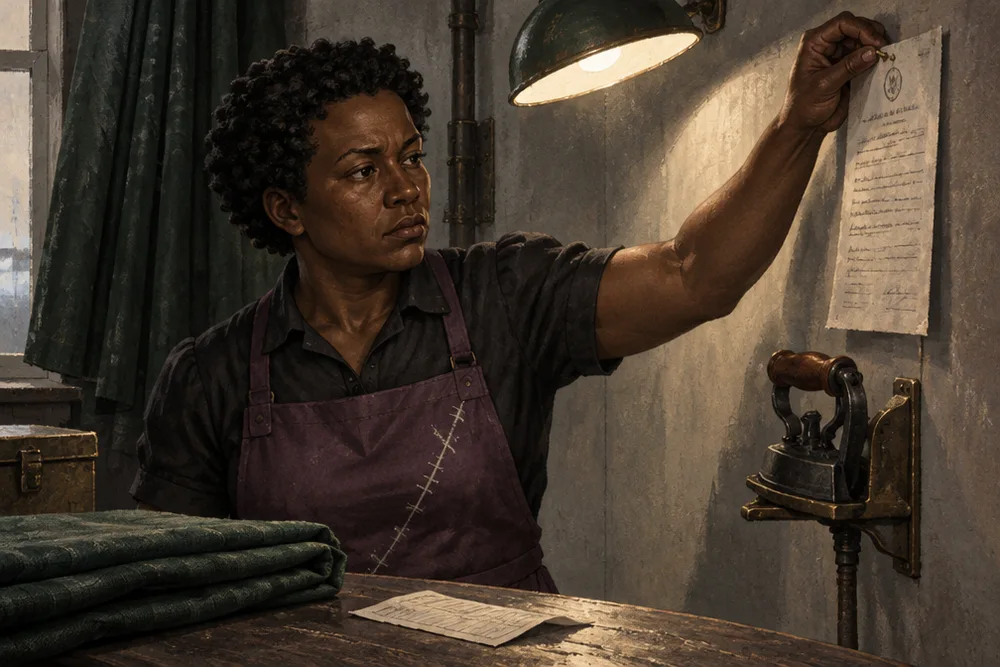
Outside, the station bell marked the next departure. Beyond the windows, the city’s lower streets were still lost in cloud. Fenna went to the counter and pinned the holding notice where anyone handling station cloth could read it. The reward offer remained unsigned in its oilcloth sleeve. The line asking for the owner’s signature was still empty.
By the time she returned to her work, the question had changed. It was no longer whether she could make a shop out of the railway’s money. It was whether she could give the people behind the seam enough room to make their own claim, and still find a way to open a door of her own.
She began pressing the next curtain. The iron moved in measured strokes over the cloth. No window appeared. When the first fold lay smooth, she stopped before the address seam and set the iron aside. The hearing would decide what the timetable carried into another year. Until then, she would keep the receipt open.