A Hem Full of Tomorrow
Page 125 of 286
Chapters
Lio came forward and looked at the ticket scrap. “I thought the opening was on their roofs.”
“Their roof doesn’t get lower. Our window does.”
He considered that and stepped away again, this time to the far side of the walking lane. Fenna asked what he saw. He said her hand, the sill, the empty room behind. She asked what he could hear. His mouth moved, but a rack of returned milk cans rattled past behind him, and she had to wait for the last can to go by before he could answer.
“Not a thing you said after ‘hear.’”
She wound the tape over two fingers. She had imagined the hearing at moments when there had been nothing much to listen to: the press heating, the cloud thinning, the last swish of a broom. The council window would face a room that had people in it. There would be shoes, papers, questions asked before an answer had come to its end. If she ever got the curtain there, she would need to know more than whether a face could be made to appear.
But a face was already more than today’s test could promise. She drew a line through the little square she had put in the middle of her sketch.
“Did you want to watch from this side?” she asked Lio. “If they give me leave to hang it?”
He took a little too long to answer. Then he freed the envelope from under his arm. It was one of the old railway kind, strong enough to send a ledger page without folding it. Someone had scraped off a previous address, leaving the paper soft and white in a long oval.
“I brought a description,” he said. “Of the place as it was when I knew it. I thought if the opening wasn’t clear, there might be something to use alongside it.”
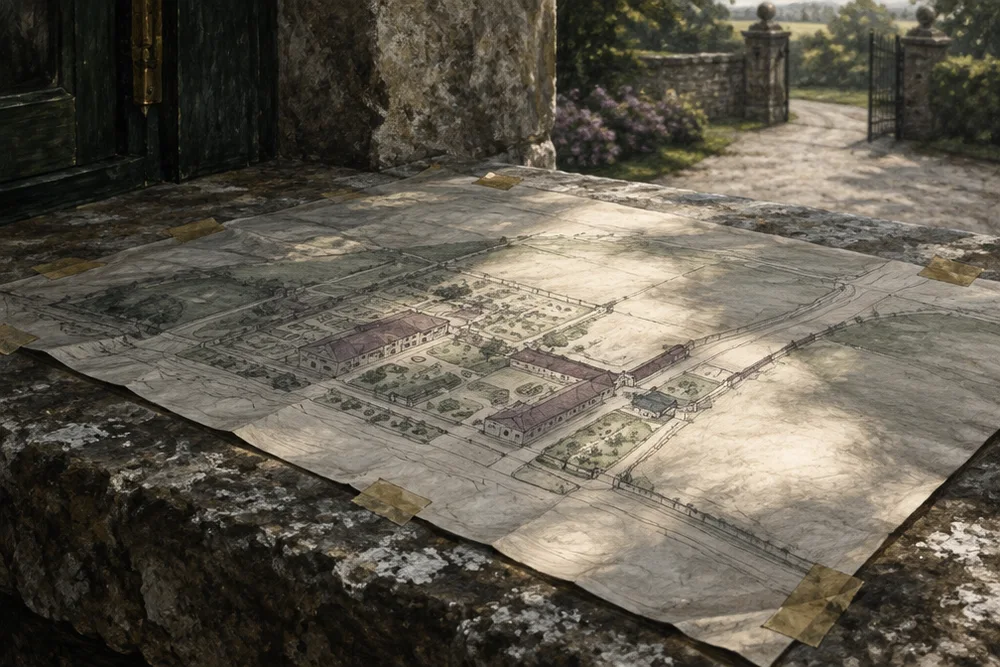
He drew out one sheet. There was a neat plan of the roofs with the stairs ruled double and the doors marked by short strokes. Fenna knew the long wash roof from the days she had been up there. Where a tenant had shown her the corner in which she boiled water, Lio had written COAL STORE.
“It was,” he said when she pointed to it. He read the words again, then added, “When I lived there.”
He had drawn a gate at the end of a passage that now ran straight into somebody’s kitchen. It would have been a handsome map to show a room full of people who had never taken the detour. They would have been able to follow every line. A clerk could have copied it in half an hour, and the copy might have looked newer than the place itself.