What the Station Keeps Warm
Page 56 of 207
Chapters
She opened the archived heating plan again. Lines from the laundry crossed under several partitions, then ran toward the cold outer curve. Some terminated at removed radiators. Others had no end mark at all. The plan was faded where it had been folded, and a small notation beside the dryer cradle had blurred into a pale brown stain.
Iona tried to match the route to the station’s maintenance map. The two drawings disagreed about a corridor wall. She used the current map to locate the nearest accessible service panel and walked the route with a probe, stopping every few metres to measure the deck. The temperature declined at the passage, rose near a seam beneath an empty linen alcove, then vanished behind a locked utility hatch.
The door’s access record listed facilities only. She filed a request rather than forcing it. The reply warned that the hatch contained decommissioned thermal hardware and should remain closed pending safety clearance. A line at the bottom noted that the panel had been sealed during the network retirement. The same retirement that had left the dryer in place.
She carried the reply back to Sef. ‘We can’t call it a pipe leak,’ she said. ‘The warmth doesn’t follow the water lines. It follows this plan, as far as the readings can tell.’
‘And you’re not asking me to identify anyone?’ he said.
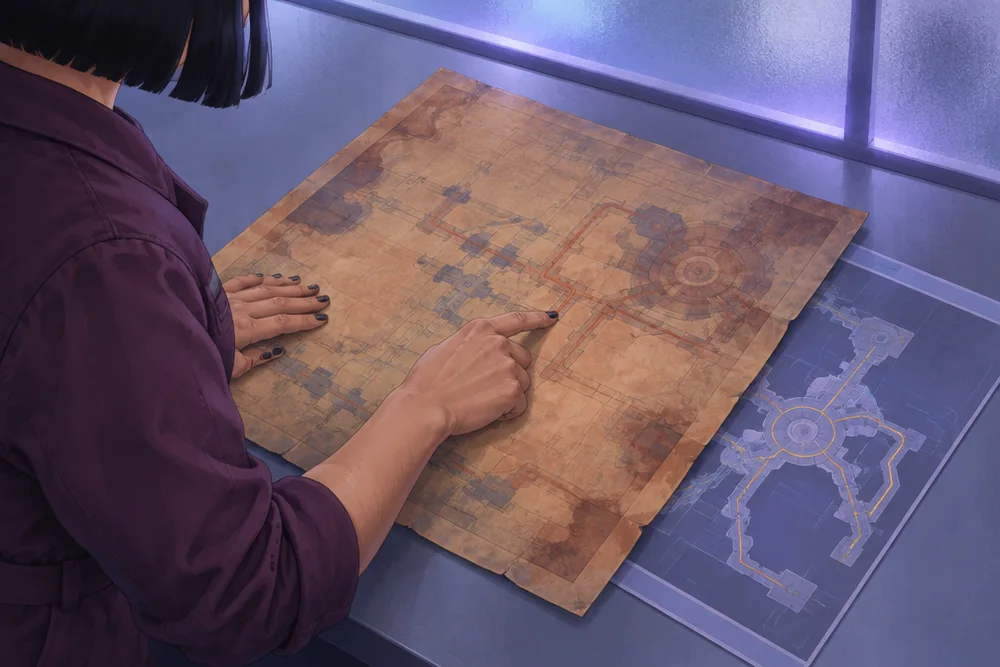
‘Not until we know what the equipment is doing.’
Sef considered that, his narrow shoulders drawn forward. He was not convinced, but he did not push her toward a name. ‘I can keep the charge in dispute for the reconciliation window. After that, accounting will have to post it or remove it. The safety review will decide what happens to the installation.’
The answer left her with less time than she wanted and more responsibility than she had asked for. She had found no cracked pipe. She had found an unpowered machine carrying warmth through a retired network, an active charge with no trustworthy meter, and a safety inspection someone had once denied.
She wrote the findings in a new folder and labeled it SOURCE, not FAULT. The distinction mattered. A fault invited replacement; a source might still explain why the heat was there. She kept the original meter sheets, the technician’s report, the old tariff description, and the inspection denial together. Four records, all credible, none sufficient alone.
At the bottom of the folder she added a note for whoever reviewed it next: ‘Do not move dryer before checking connected floors.’ She could not explain why she wrote it. The plan suggested a route, and the warmth under the deck had pointed outward. It was enough to make moving the machine seem like a decision with consequences rather than a repair.