What the Salt Spoon Holds
Page 6 of 8
While the dough rose, Veda and Obel fitted the plank. She marked the curve with her pattern and sawed by lantern light. Once she went too close to the line and had to stop and change the way she stood. Obel didn't reach for the saw. He put his foot on the waste end so it wouldn't shake.
They planed the edge, tried it, took it off, and planed it again. When it finally sat flush, Veda held her palm across the join. Then she fixed the plank to the ribs and worked a wad of tarred fiber into the seam. Obel passed her the narrow tool before she asked. The spoon lay on the sill behind the lantern, its bowl turned away from the light.
By morning the ferry was finished, but there was no water to put it in. Veda went to the bakehouse for the bread. Ida had made flat rounds that would tear easily. Neither of them tried a piece. Veda tucked the warm rounds into a basket, put the spoon back in her pocket, and took a pair of old hatch boards down to the mud.
She put one board flat, stepped onto it, and laid the other ahead. Then she turned to pick up the first. In this way she made herself a road that was only ever two steps long. By the time she reached the first boat her boots were heavy with mud and her basket handle had worn a red stripe on her wrist.
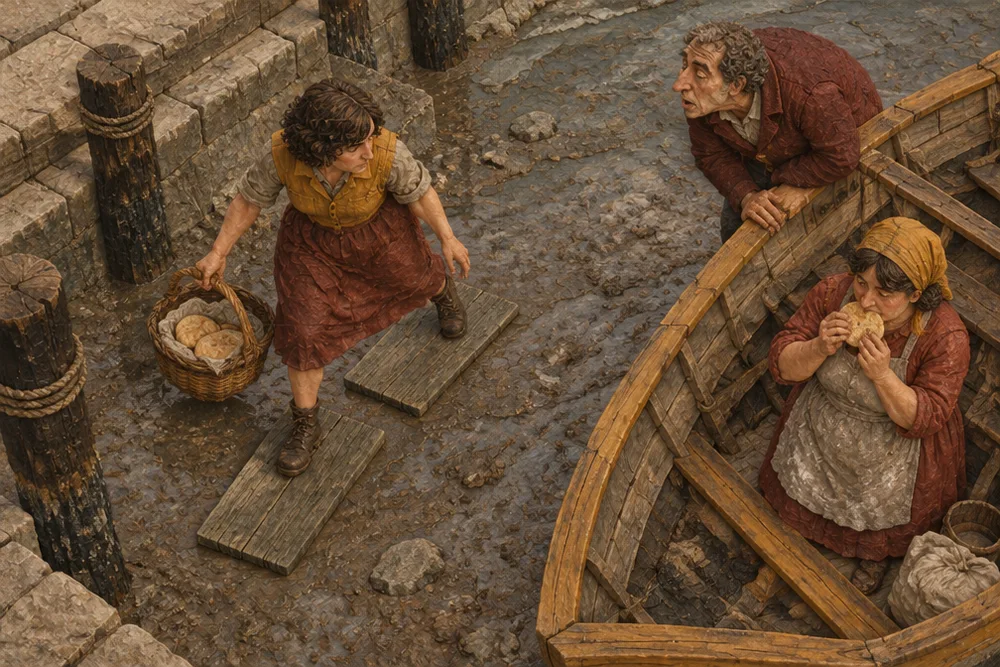
The woman in the boat had spent the night shifting her catch from the low side to the high. She took the bread standing up. Veda waited until she swallowed. ‘What do you hear?’
‘A broom,’ said the woman. ‘My brother used to sweep the yard before anybody else got up. I always thought somebody ought to tell him we could hear him.’ She took a second bite. ‘I never did.’
On the next boat a man heard the squeak of the gate a goat used to open with its nose. On the next, a boy heard his grandmother saying his name in the way that meant he'd better come quickly if he wanted the spoon from the jam pot. He leaned down to tell Veda how she said it. He had to try three times before he got it right. Veda held her boards still and listened.