What the Roof Gives Back
Page 23 of 229
Chapters
Dina Sarelmi unfolded a sheet of paper. The notice was one of the park’s ordinary announcements, chosen because it had a date, a name, and enough consonants to expose a muddy return. Vera repeated it from the mark, speaking at a comfortable volume. Her voice traveled beneath the canopy. The closest listeners nodded.
Kit did not.
Vera finished and turned toward her. “What did you hear?”
“I got the month and the part about the lawn,” Kit said. “Not the name.”
“Which name?”
“Sarelmi.” Kit lifted their chin toward Dina. “I heard something like ‘Ser—’ and then it went soft.”
Dina raised her paper. “It’s my name.”
“I know.” Kit’s face warmed. “I’m sorry. I’ve heard it before. I just couldn’t get it from here.”
Rianne looked at the space between the bandstand and Kit’s chair. The tables made a shallow fan, each row angled a little farther downhill. She had measured their clearances on the plan and marked the path, but the drawing gave every listener the same neat circle for a head. It had not given Kit’s ears a place to stand—or sit.
“Try again,” Vera said. There was no scolding in it, but the words landed with the insistence of a person who trusted a test she could repeat.
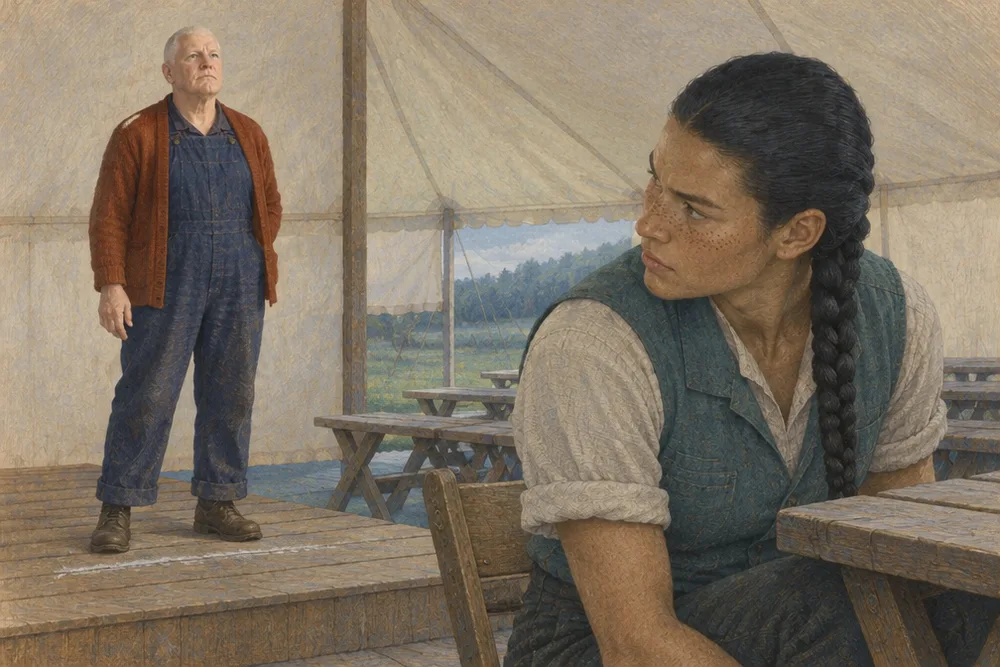
She read the notice once more, then shifted her weight, chin lifting. The note had sounded best when she did that. The sentence did not. Kit leaned forward, listening hard, and shook their head when Vera finished.
Rianne put a small cross on her field sheet at Kit’s chair. “Can you tell whether the trouble is the whole sentence or certain sounds?”
“The ends of words are going first. And the middle of her name.” Kit paused, searching for the distinction. “I can tell she’s saying a name. I can’t tell which one.”
“Was the voice loud enough?”
“Yes.”
Vera stepped down from the mark. “A singer can articulate more. You can’t ask the roof to fix a swallowed word.”
“True,” Rianne said. “But Kit heard the words from the standing position. We changed one thing.”
“We changed where she is.” Vera’s pale eyes flicked to the chair. “The audience doesn’t all sit at the edge of the second row.”
“That’s why I want to map the seats before I move anything.”
Rianne opened her notebook to a clean sheet and sketched the six rows as they lay: two tables nearest the dais, then four fanning toward the accessible path. She marked the canopy posts, the path’s turning space, and the places where chair legs could not intrude. She added Kit’s position, then asked them to move. She wanted to see where Kit might choose to listen.