What the Roof Gives Back
Chapter 22 · No Solo Required
Page 206 of 229
Chapters
By eight, the picnic lawn had filled with folding chairs, paper cups, and people pretending not to watch the bandstand. Rianne stood just beyond the dais with the program folded in her ochre coat pocket, counting table rows instead of faces. Six, fanning downhill toward the accessible path. At the far end, a child in a yellow rain hat swung her feet beneath the last table. Beyond her, the path shone damply under an overcast sky.
The restored canopy looked almost unchanged from a distance: oak posts, iron braces, a roof broad enough to shelter the whole low dais. Up close, the inner panels were subtly different, their angles set by months of tests. The chalk mark remained just off center, faint now beneath the varnish. Rianne had asked the crew to leave it visible until after the reopening. It was not a monument. It was a place to stand and begin again.
Kit Anwar waited at the mark, teal vest bright against the dark boards. Their long braid lay over one shoulder, and they had a clipboard tucked beneath an elbow. They were checking the order with Vera Pell, who stood wide-footed in indigo coveralls and a rust cardigan, chin lifted as if the canopy had once personally challenged her. Dina Sarelmi moved between them with a stack of programs, giving instructions in the quiet, efficient manner of someone who had already solved three small problems before anyone else noticed them.
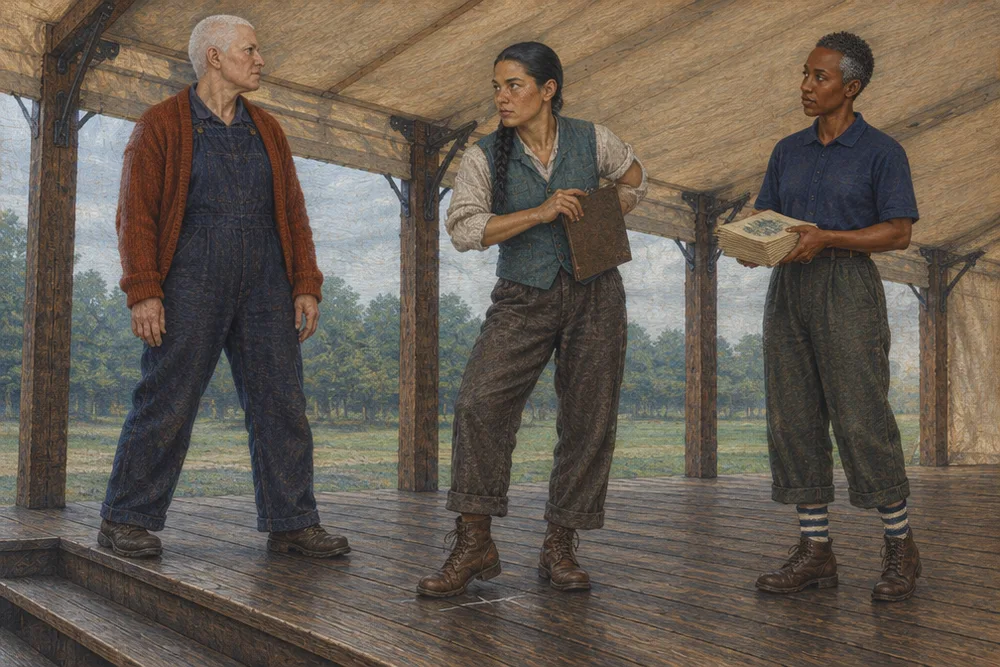
Rianne’s hands wanted to clasp behind her back. She kept them at her sides. This was Kit’s event to run, and Dina’s program to make workable, and Vera’s crew’s knowledge to carry forward. Rianne’s work was in the roof, the measurements, the compromises made between a strong voice and a tired one, between a standing listener and a person settled in a chair. The work was not improved by her standing in the center of it.
Jonah found her near the accessible path. He wore his plum shirt rather than a suit, sleeves rolled to the forearms, cream jeans and green canvas shoes darkened at the toes by the wet grass. He leaned forward from his ankles as he did when listening closely. The look he gave her was warm, but not expectant. Since they had agreed to ask before rearranging each other’s lives, she had learned to notice the space he left for her answer.
“You’ve got the best seat,” he said, indicating the last table. “No one will ask you to say anything from there.”