The Weight of One Pebble
Page 40 of 261
Chapters
His mouth tightened, but he did not answer. Ottilie stood and fetched a straightedge from her tool roll. She had thought the proposed inscription merely wrong; now she wanted to know exactly what it would do to the stone. A bad sentence could be refused as a matter of truth, but a crowded sentence might be refused as bad work. That was a narrower foothold, and she would take it if she could make it hold.
She laid the straightedge along the broad face of the new base, then chalked the proposed lines in their approximate height. The lettering had to be large enough to read from the stair and the ferry stage; a ceremonial inscription in cramped type would look like a shop account copied by a clerk with no wall space. She marked a margin at either end and a deep lower band where the stone needed to remain sound under the block’s weight.
“The line is longer than you’ve allowed,” Denzil said.
“I know. I’m laying it out as they sent it.” She stepped back to the angle from which passengers would see the face. The block’s grip hollows would catch the carriers’ hands; the base would bear the load above them. “The words need room. The capitals need room. The name of the mayor takes more width than the name of the borough.”
“You might abbreviate.”
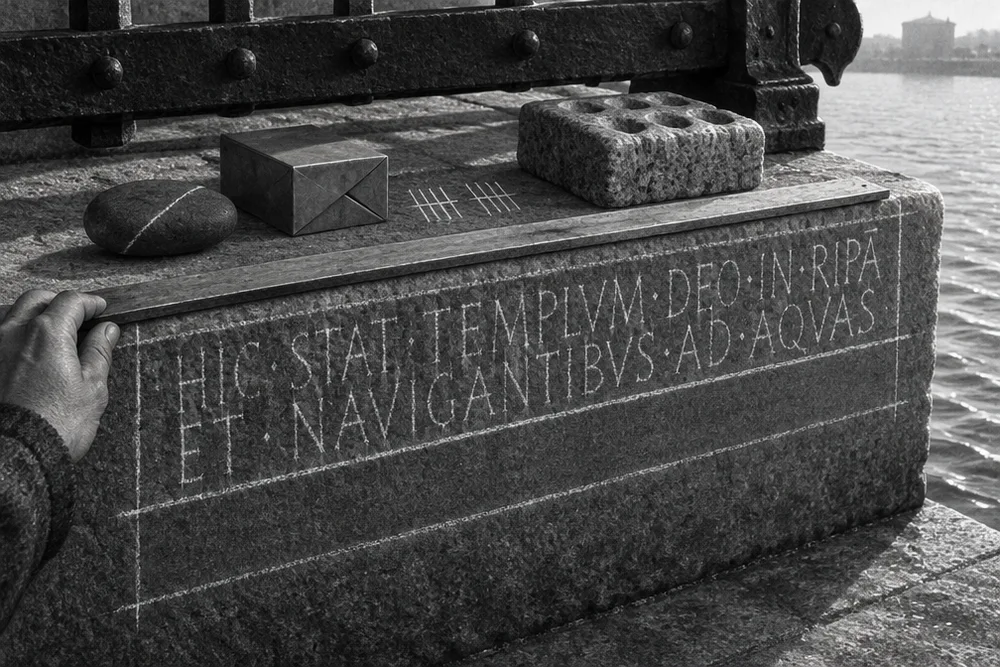
“Not by my hand.” She used the chalk to show the narrow space remaining. Even without the final words, the proposed text pressed close to the edge. She knelt again and measured from the bottom of the first line to the highest point where the stone would meet the block. A deep cut there would weaken the bearing edge, where the weight had to sit without rocking.
“If I keep their lettering shallow, it will be gone in weather,” she said. “If I cut it deep enough to last, it enters the bed. A crowded panel leaves no shoulder. The block will have a seam of letters where it needs solid stone.”
Denzil examined her marks. “You are saying it cannot be done safely as written.”
“I’m saying I won’t sign work that may fail because the committee wanted a sentence longer than its face.” She heard how hard she sounded and let the words stand. She had learned early that a cut, once started, did not become reversible because someone regretted it.
Denzil brought his hands out from behind him. From an inner pocket he took a little book with a pencil caught in its fold. He laid the book open on the cradle and wrote standing up, his left hand spread across the two leaves.