The Weight of One Pebble
Page 30 of 261
Chapters
“Let them see the old entry before they give you the words,” he said. “There ought to be an entry for the base.”
Ottilie began to fold the order, then stopped with the corners matched. “Would the man who made it have had a paper like this?”
“He might have had the terms read to him. There should be a minute authorizing the expense, whether he had a copy or not.”
“The base broke. The block didn’t. If there’s an order for the block, wouldn’t that be the one to read?”
He had been thinking of what a previous mason had been bound to deliver. She was asking what the borough had bought the stone to do. Denzil knew the shelf for that: the watergate works were entered by year, with the larger charges indexed at the back. Ottilie pressed the fold with the heel of her hand and put the order away.
He set aside the sheets and opened the ledger that recorded the replacement of the first granite block. Its paper was newer, its entries written in a clerk’s compact hand. The date fell decades after the ferryman’s note. Denzil found the instruction for the stone beneath a list of repairs to the watergate and read it once without speaking.
“What?” Ottilie asked.
“This is the authority for the granite block.”
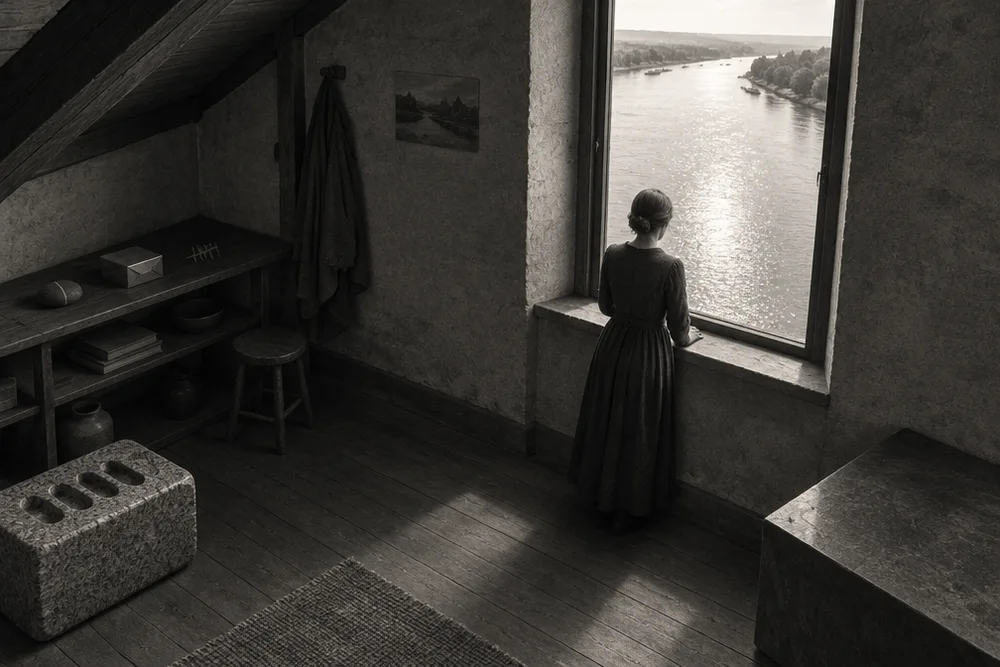
He angled the ledger toward her. The entry directed that a stone be set at the annual reckoning, to stand for the borough’s account of crossing fares. The instruction named no particular payment and no woman. It did not say that a mayor had paid fares for the poor. There was no act of generosity in it, no remission, no public debt discharged by an elected man.
“Read the exact words,” Ottilie said.
Denzil did. The phrase was plain and formal: the block was to represent fares carried forward in reckoning. Another line recorded payment for the stone and its setting from borough funds.
“There,” said Ottilie. “The block came after the pebble. Not because a mayor paid.”
“The record gives no connection between the mayor and its making.”
“But the broadside does.”
“A later broadside does.”
The distinction mattered, and he heard how thin it sounded beside the words he had read. In the official account, a later public telling had hardened into origin. The ledger, older and closer to the decision, gave no support to that telling. It did not prove every part of the old note, but it took the mayor’s generosity out of the stone’s recorded beginning.