The Tide Between Our Lines
Page 97 of 216
Chapters
The launch nosed away at five on the minute. Gethin kept the engine low as he cleared the quay, then turned toward the departure pier marked on the trial sheet. Xanthe remained ashore, her figure shrinking against the sheds. He could still see her lift the board and look along the road, counting arrivals that had not arrived. The benches stayed empty. No one had been waiting at the pier when he cast off.
The route took him past the old clock shelter and the mouth of Rivet Walk. At this tide the public stones showed in a narrow strip, but the shop’s private doorstep lay dark beneath the water. Gethin followed the marked course and watched the landings slide past. He could do the run safely. That was not the same as proving that people could use it. The operator’s worksheet had a box for passengers and a box for fuel. Nothing asked whether the bus had brought anyone in time.
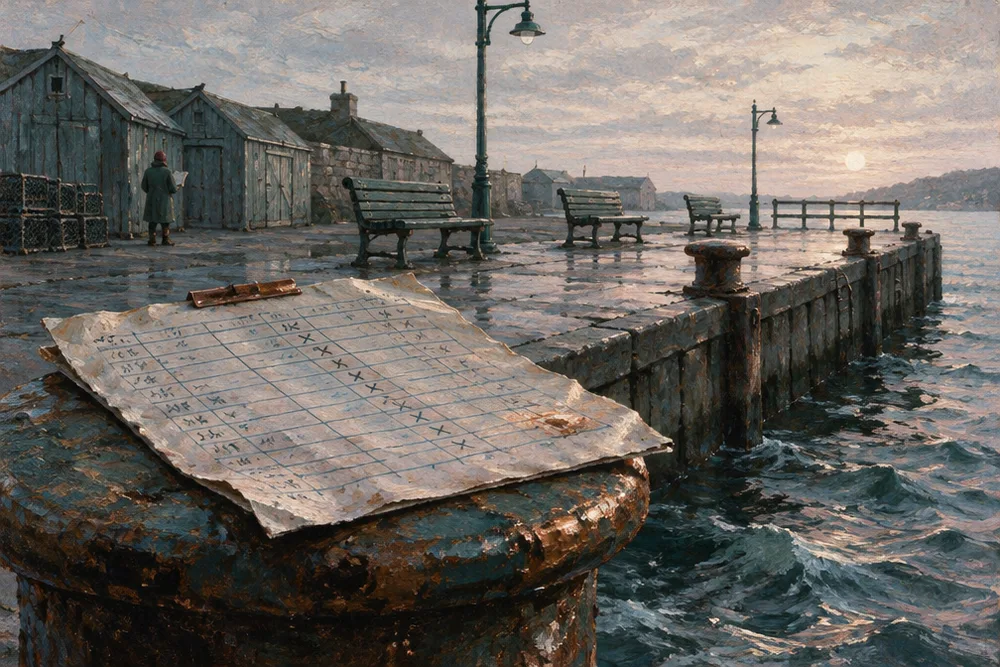
At the far end he turned into the chop and brought the launch back. A gull swept low over the stern, then veered off. The wake rattled the mooring chains where the pier met the shore. Gethin tied up and wrote the figures: departure, return, tide state, fuel. Passengers: zero. He pressed the ticket punch into the blank box as the form required, the square hole neat and final.
Xanthe joined him with the counting board. “I had three who might have used it,” she said. “Two graders and Pell. None could reach this pier by five.” She tapped the road side of the sheet. “The bus brings them after the boat leaves.” Gethin looked toward the road. Nothing moved there except a blue-gray haze lifting above the roofs. “Pell didn’t come?” “He’s coming now.”
She sounded neither disappointed nor triumphant. The trial was evidence, and evidence could be thin. Gethin wrote the bus arrival time in the margin. He had not been asked to do that. “The operator will say the run had no demand,” he said. Xanthe folded the sheet along its old crease. “Then they’ll be right about the boat they scheduled. Not about the people who need one.” The distinction made the empty benches feel less like an answer.