The Tide Between Our Lines
Chapter 2 · A Tin for Two Shifts
Page 10 of 216
Chapters
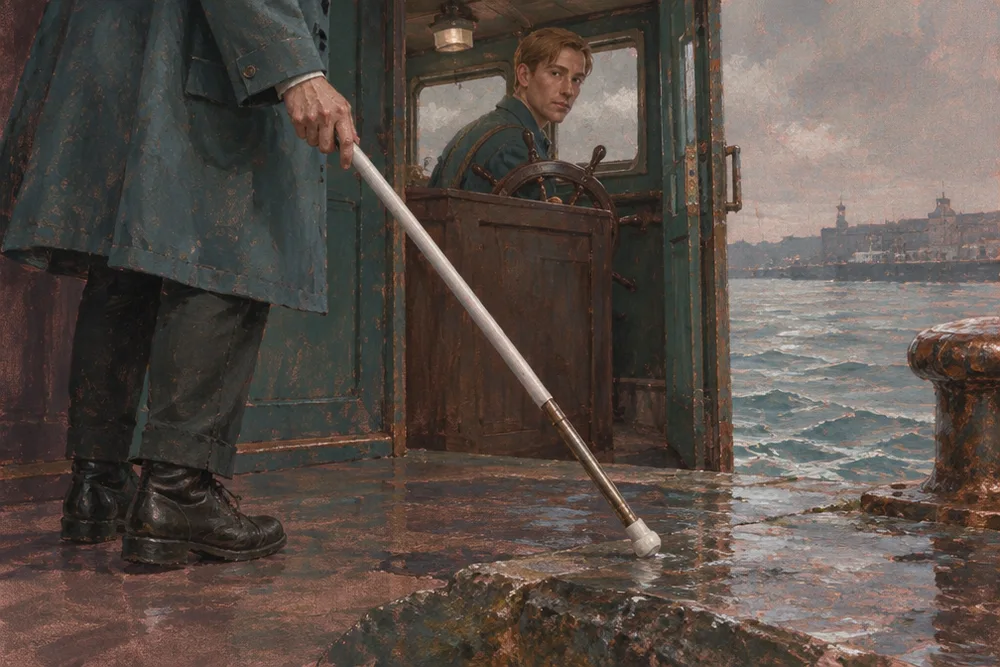
The last grader came down the quay with one boot unlaced and a tin lunch pail knocking his knee. Gethin held the ferry against the landing while the man turned his whole torso to find the rail, then stepped aboard. Behind him, two more graders hurried from the Weighhouse, mustard-colored work trousers dark at the cuffs. The harbor clock showed a quarter past six. Their shift had ended; the visitor boats had not yet begun their morning runs, and the employer’s timetable had no place for them now.
“You’re late,” Gethin said, though he had waited nine minutes.
“We’re finished,” said the first grader. “Late’s what they call us when we’re still here.”
The man’s name was Pell Roake. Gethin knew him by sight and by the white-handled cane he used to test the landing boards before trusting them. He had never asked why Pell turned his whole body before stepping, and Pell had never offered to explain. They knew one another in the way people on a harbor knew a rope: by what it could bear, not by its history.
Gethin punched three tickets with his ivory punch. The graders paid from coins already laid out in their palms. Their employer would not underwrite the run, and Gethin’s operator had not authorized it either. He took the fare because a boat was already going that way to sound the channel, and because the men needed to get home. He entered the crossing in the margin of his own log as a private favor, then pushed off.
At the first turn, Gethin cut the engine and let the boat drift while he listened to the water. The tide slid between the pilings with a soft sucking sound. Pell sat forward, cane across his knees, looking toward the dark shoreline. The other graders leaned back against the rail and shut their eyes. A person who had worked grading floor since before dawn could sleep sitting upright through anything, Gethin had learned, except a missed landing.
“You’re taking us past the old clock shelter?” Pell asked.
“That’s the route.”
“It isn’t the route when the tide comes higher.”
“Tonight it is.” Gethin turned the wheel by a hand’s width. “I’ve sounded it.”
Pell gave no answer, but his cane shifted against his boot. Gethin watched the waterline instead of asking what the man thought of his judgment. He had enough experience to know that a route could be passable and still be wrong for a particular person, and not enough patience to hear that lesson before he had made the mistake himself.