The Tide Between Our Lines
Page 88 of 216
Chapters
Xanthe tried to imagine moving the press. It was not practical; it was a thought that arrived whenever she faced a locked door. The platen had been lowered into the stone floor before the shop was finished. Its weight belonged to this place. So did the paper loft, with its high rafters and the small window where the late light reached the drying sheets.
“You could sell the rights and still buy the shop,” Mera said, as if she had read the thought. “You could run the press. You could take orders from people who already know you.”
“And print what the board lets me print.”
“Maybe.” Mera’s hand rested beside her keys. “You might decide a shop is worth more than a map. I might decide a dry flat is worth more than a threshold. Neither of us has to pretend it’s noble.”
Xanthe looked down at her ink-dark thumb. She wanted the shop as a place of work, not as a trophy. She wanted to make something useful without having to ask permission to reproduce it. Those wants had seemed like the same thing until Orla put a price between them.
“I’ll read the terms,” she said.
“Do.” Mera turned toward the rear passage. “Read them before you tell yourself there’s only one choice.”
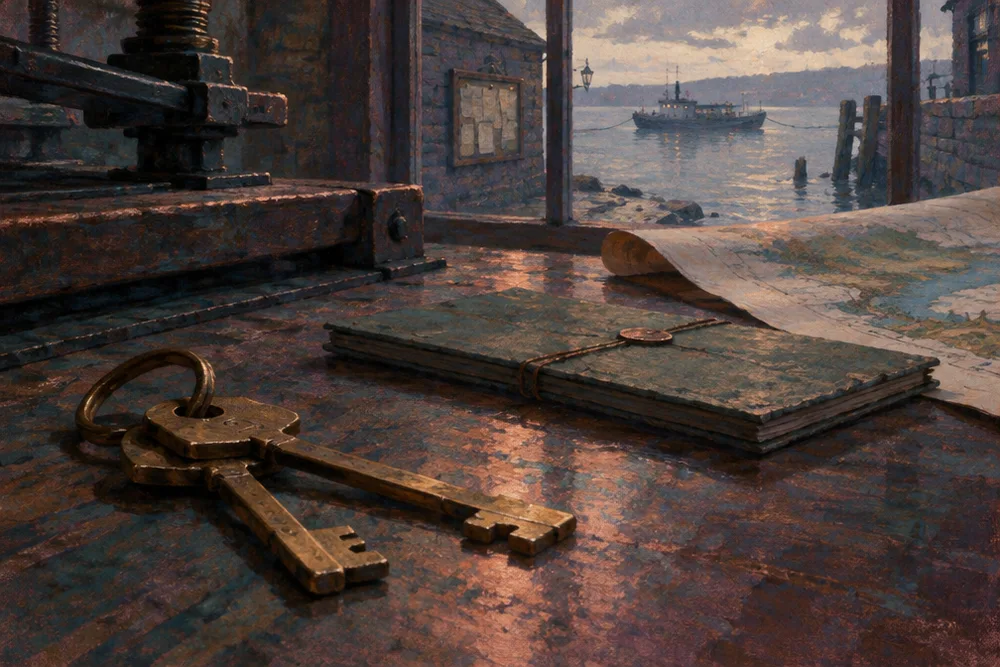
After Mera left, Xanthe carried the proof upstairs. From the paper-loft window she could see the harbor board’s notice pinned at the Weighhouse and, farther off, the ferry swinging on its line. The tide covered the lowest stones of Rivet Walk. The route had become a dark seam between the shop and the shore.
She spread the survey sheet on the loft table and set Orla’s offer at its corner. The map was not yet a finished edition. It had begun as a contract job: lines, levels, and a clear account of where the harbor’s footpaths disappeared. The board had paid an advance for the work. The blocks belonged to her by contract. None of that meant the board was entitled to use the map to make every crossing look alike.
She had spent the early weeks learning how to mark what she couldn’t see from shore. Gethin’s small woodcut had corrected her drawing of a submerged tread. Pell had shown her that a turn could be dry and still leave no room for a cane. The details had come from people whose work took them across the harbor when the visitor ferries were nowhere near the landing.
The offer called the map authoritative. Xanthe wondered whether authority meant a larger font or simply the right to leave out whoever complicated the answer.