The Tide Between Our Lines
Page 45 of 216
Chapters
She looked. The mark was a leftover note for the submerged step, now stranded beside a crossed-out line. Pell was right. She erased it until only a pale smear remained, then added a broken band along the route’s short approach, the symbol she had been testing for a section excluded from the trial.
“Does that read as closed?” she asked.
“It reads as broken. Which is honest. Put the words beside it.”
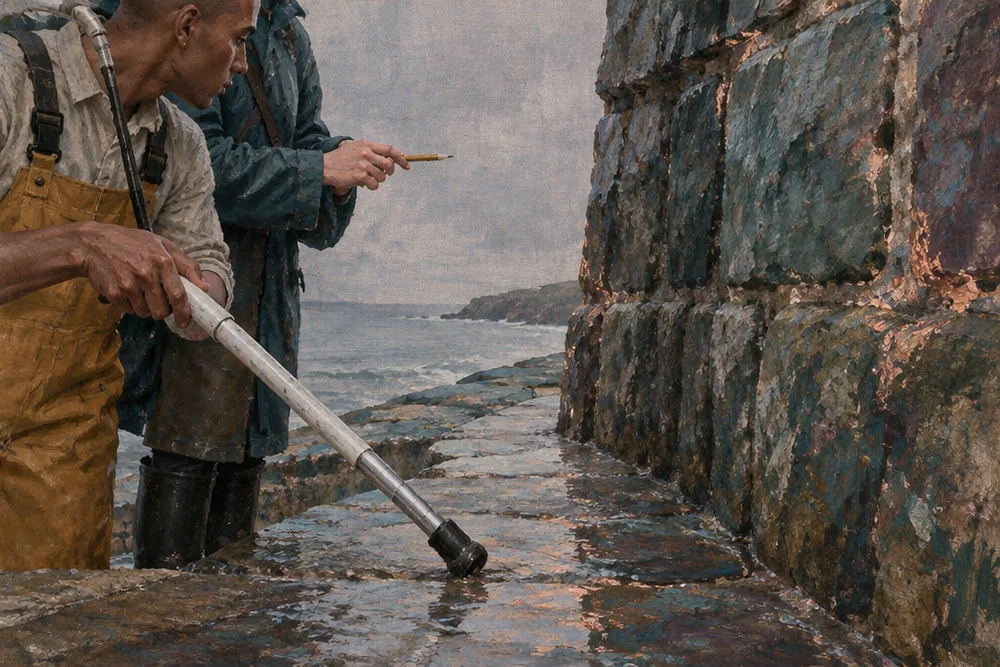
They walked back toward the public path without descending. Pell set the pace, and Xanthe kept to his left so the cane had room. At a tight bend, the stone wall pushed the path inward. A person with a basket could pass there, but the space between the wall and the drop narrowed enough that Pell’s cane had to test the ground ahead before he could shift his weight.
Xanthe measured the turn with her eyes. The route on her draft showed a smooth sweep. She had drawn a single line to stand for a path that changed width twice in the space of a few steps.
“I thought this was the wider way,” she said.
“It is, compared with the lane behind the grading shed.” Pell tapped the cane at the inside edge. “Doesn’t make it wide.”
She brought out her folding rule. “Where does it pinch for you?”
“Where the stone juts. Not here.” He pointed to a spot a little farther on. “I can get through. Someone walking beside me has to turn sideways. If the ground’s slick, I need room to bring the cane round.”
Xanthe measured the clear width and wrote it down. “I can’t make a measurement promise everybody can use.”
“No. But you can show where it changes, and who measured. Then people know what they’re deciding.”
The answer unsettled her because it was not a way around the problem. It was a way to put the problem where a reader could see it. A neat line would cost less room on the sheet. It would also ask people to supply their own missing information, as if they were all arriving with the same legs, the same cane, the same balance.
Pell continued along the path, stopping where the wall fell back. “That’s enough for me. Here I can move it.”
Xanthe measured again, then added a small width bracket to the margin. She dated it. The number looked exact, almost official. She wrote OBSERVED CLEAR WIDTH, not simply WIDTH. The two extra words crowded the margin, but they changed the claim.
“You’re going to need a bigger sheet,” Pell said.