The Tide Between Our Lines
Page 38 of 216
Chapters
A deckhand called from the quay. “You found something?”
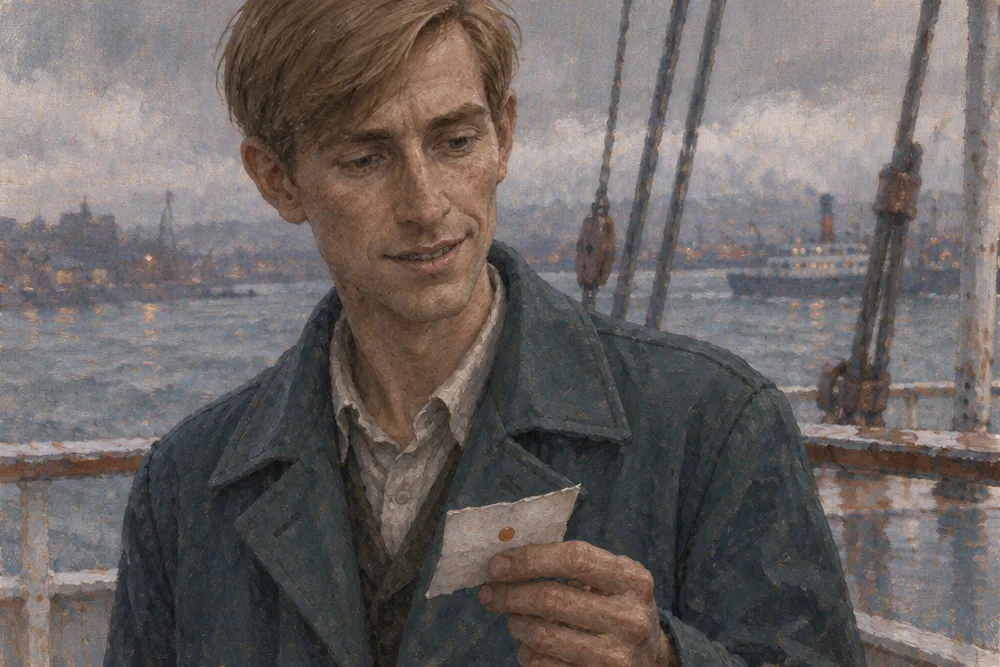
“A correction,” Gethin said, and tucked the slip into the breast pocket of his coat.
“Looks like paper.”
“It’s both.”
The deckhand laughed and went back to coiling a line. Gethin leaned against the rail, eyes on the opposite shore. Across the harbor, the windbreak lay dark below the net shed. The paper-loft window was a pale square above the rising tide. He wondered if Xanthe was still inside, perhaps cleaning ink from her hands or checking the next proof. He wondered how long she had watched the harbor before choosing that spot for the mark.
The ferry horn sounded once from the mooring. He had to finish his checks, sign the log, and leave the slip somewhere it would not be soaked through before he got home. He might have put it back in the tin. Instead, he kept it near his chest.
That night, he laid the scrap on the narrow table beside his bed. He did not press it flat; the curl along one edge made it look as though the paper had tried to turn toward him. The copper dot beside the drawn window sat close to the rivet line, but not on it. He thought of the first time he had seen that line on Xanthe’s proof: the route down to a door whose iron ring waited above the latch.
A line on paper could tell him where the stones were. It could not tell him whether she wanted company. Her dot was not a promise. It was not a request he could answer with a ferry ticket or a correction to a survey. It was simply the mark of a place she had chosen to show him.
He could go there, he thought. He could also wait for her to make it clearer. The tin had room for another note if he wanted one. The mark had not asked him to hurry.
He left the slip on the table and turned out the lamp. In the dark he could still see the faint copper shine where it caught the window light.
The next day brought rain, and the ferry ran under a sky so low it seemed to press on the mast. Gethin kept his eyes on the water and the passengers’ hands on the rail. He carried the slip in his inside pocket, folded once so the drawing would not crease across the window. By midafternoon the paper had softened at its corners, but the copper dot remained visible.