The Tide Between Our Lines
Page 29 of 216
Chapters
She sharpened the lettering on the key and left a clean margin for the tide time. Then she set the blocks in a row: Gethin’s notch, her paired bars, and a blank space for whatever the next walker showed them. The map would not be finished by two people drawing alone. It would have to meet the harbor at the pace of other feet.
When she closed the shop, the low route was already gone beneath the water. Xanthe took the longer way back, carrying the marked proofs against her plum jacket. In the tin, her note waited beside Gethin’s first correction: a small answer, and room for more.
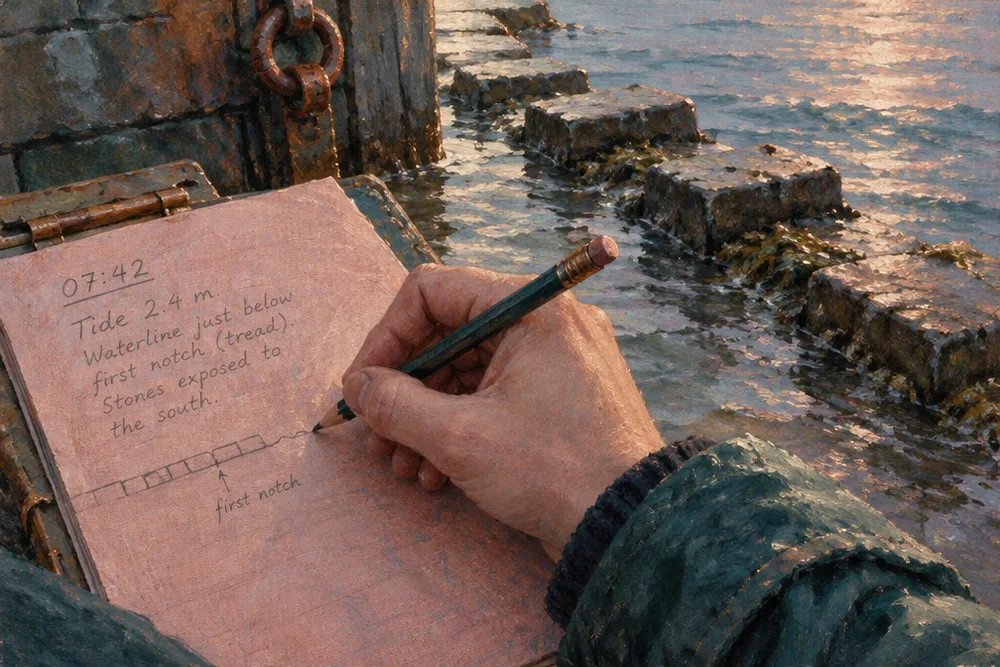
The next morning she returned to Rivet Walk with the revised proof and a stub of chalk. She wrote the time at the top, checked the tide table pinned inside her coat, and compared the waterline with the exposed stones. The notch on the page corresponded to the tread now disappearing beneath the wash.
She did not put a number beside the cut. Instead, she recorded the observation time and left space for another. It would not tell a reader what the tide would do tomorrow. It would tell them what had happened when someone looked.
At the turn, the paired bars sat beside Pell’s note about the cane. Xanthe stood where she had stood with him, then shifted her boots to the side, testing how much room her body used when she turned. The route was narrow even for her. She could pass, but only by angling one shoulder toward the wall.
Her head tilted. This time it was not disagreement. It was the feeling of an assumption coming loose.
She wrote beside the bars: Turn requires more room than shown; confirm with user. The sentence was not elegant. It was honest. She could hear Pell’s voice saying that a route was not clear merely because she could make it through.
At the lower landing, two graders came along carrying their lunch tins. Xanthe raised a hand and asked if they would look at the sheet. One stopped; the other continued, already late. The one who stayed pointed to the blank space beside the notch. “You need the tide stage here too,” he said. “High enough to wet the third step, low enough to leave the fourth.”
Xanthe wrote it down. The route gained another condition and another question. She watched the worker move on, then folded the paper so the new note would not rub off.
Across the harbor, a ferry turned in its berth. Xanthe thought of Gethin’s long fingers fitting the first block into the tin, correcting her drawing without a scale. She had understood what the cut meant. Now she understood the limit of understanding one another by marks alone.