The Tide Between Our Lines
Page 25 of 216
Chapters
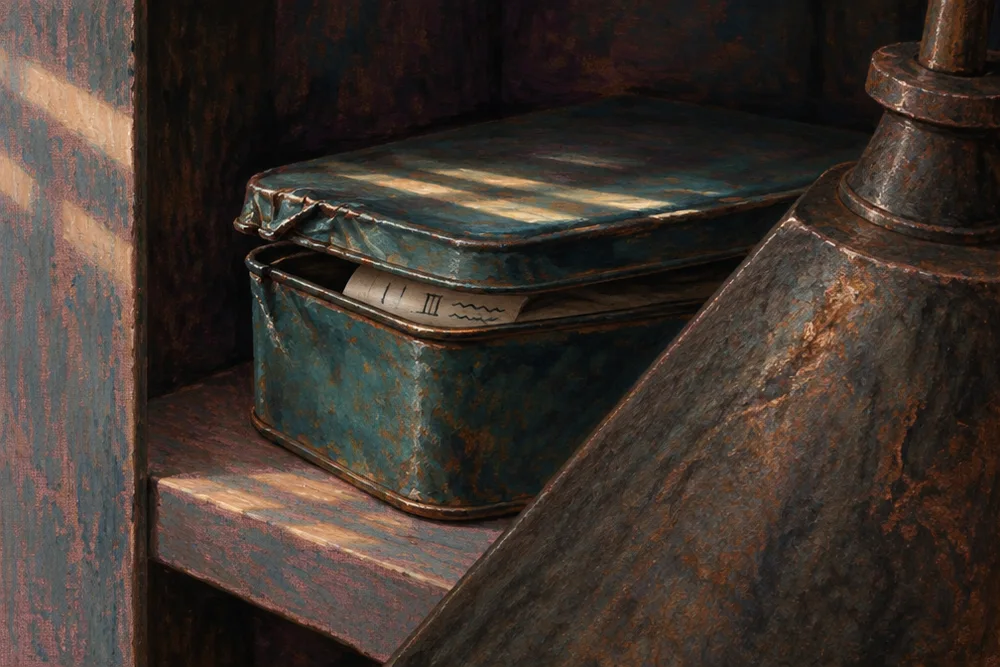
She put her revised symbols in the tin: one notch for footing lost under water, two bars for a turn with too little room. Beside them she tucked a curled proof slip, the tide-time note written in the margin. She was not sure when Gethin would come through; their shifts still passed without meeting.
A ferry horn sounded across the harbor. Xanthe closed the tin and wedged it back into the recess, then reconsidered. The proof was too important to leave hidden where damp could soften it. She opened the lid again and carried the paper to Half-Door Press, leaving the blocks in place.
At the shop, she set the proof under a clean board, out of the way of the platen. Then she returned to the Salt Shelf with a short message written in pencil: I read your notch. It marks disappearance, not depth. I’ve added a mark for a turn too narrow. Will test with more feet.
She slipped the note beneath the blocks and pressed the tin shut. That small answer felt insufficient, but there was no sensible way to make it larger. The harbor could not be surveyed by a pair of hands alone. The map needed workers who knew the landings, people whose paths were not captured by Xanthe’s stride or Gethin’s ferry schedule.
At the Weighhouse, the graders would be changing boots before dawn. Xanthe pictured the public notices pinned above the rack, the damp hems, the arguments that would happen over a line she had drawn too confidently. She would bring paper and listen before she defended a mark.
On her way back, she passed Rivet Walk. The lowest stones had already taken on a thin wash of water. She could see the path narrowing at the turn, though in the dusk it looked almost roomy. Tomorrow she would make the proof clearer. Tomorrow, other feet could tell her what she still could not see.
The next day Xanthe carried the marked proofs to the Weighhouse in a paper wrapper. Graders were coming off the floor in shifts, boots thumping against the rack, hands rinsed but still smelling faintly of shellfish and brine. The notices above them were crowded with ferry times, wage changes, and a handwritten warning about a loose plank.
She set the sheets on the bench below the notices. “I’m revising the walking routes,” she said. “I need people to tell me where the drawing lies. You don’t have to give me your name.”
One grader, a woman with a red wool cap tucked into her pocket, glanced at the papers. “You’ve drawn Rivet Walk like it belongs to you.”