The Tide Between Our Lines
Page 22 of 216
Chapters
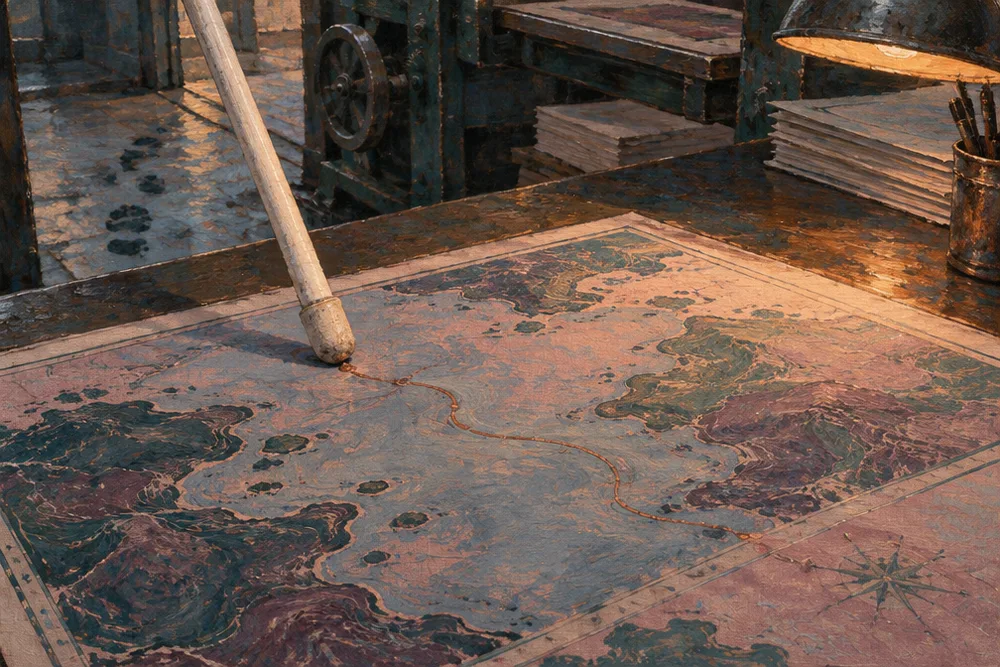
Pell Roake arrived after the shellfish grading shift, black rubber boots leaving dark commas across the threshold. His white-handled cane tapped once on the stone. He turned his whole torso before stepping around the press table, careful of the stacked paper. Xanthe saw the effort, but not yet what the map had missed.
“You asked me to look at the turn,” he said. His mustard bib trousers were still wet at the knees. “I brought my cane. Thought I’d bring the part you drew for.”
“Good,” Xanthe said. She reached for her coat. “The route’s clear now, if the tide holds.”
Pell looked down at the proof. “Clear for whom?”
The question landed harder than its quiet delivery. Xanthe felt the beginning of a defense rise in her—she had walked it herself, checked the stones, taken measurements. Her head tilted before she could stop it. “Show me.”
He studied the drawing a moment longer, then tapped the turn with the cane’s white handle. “Here. You’ve given me the wall on one side and the edge on the other. Your line goes through the space between.”
“There’s room.”
“For your boots.” Pell set his cane tip on the paper. “Not for this beside me.”
They went out together. The morning tide had dropped farther, uncovering a narrow run of stone from the public landing toward the shop. Xanthe walked first, counting rivet heads under her breath. Pell followed at his own pace, turning his shoulders to keep the cane clear of the wall.
At the turn, his cane struck the inner stone. He tried to bring it around, and the tip skated off the outer lip. Pell stopped before his boot moved. His shoulders rotated; the cane remained pinned between wall and edge.
“That’s the room,” he said.
Xanthe looked down at the path. It was not a room so much as a passage shaped by stone, with a slant in it she had never noticed. She had thought the cane needed only to find the next tread. It needed space to swing, to test the ground before Pell committed his weight.
“Could you come through if I moved the line?” she asked.
“Not by drawing more pavement.” He withdrew the cane. “The stone’s the stone. If I go sideways, there’s nowhere to put my foot. If I turn here, I’m standing on the edge. I can use it with help, sometimes. That’s not the same as a route you can put on a notice.”
“And the tide?”