The Tide Between Our Lines
Page 16 of 216
Chapters
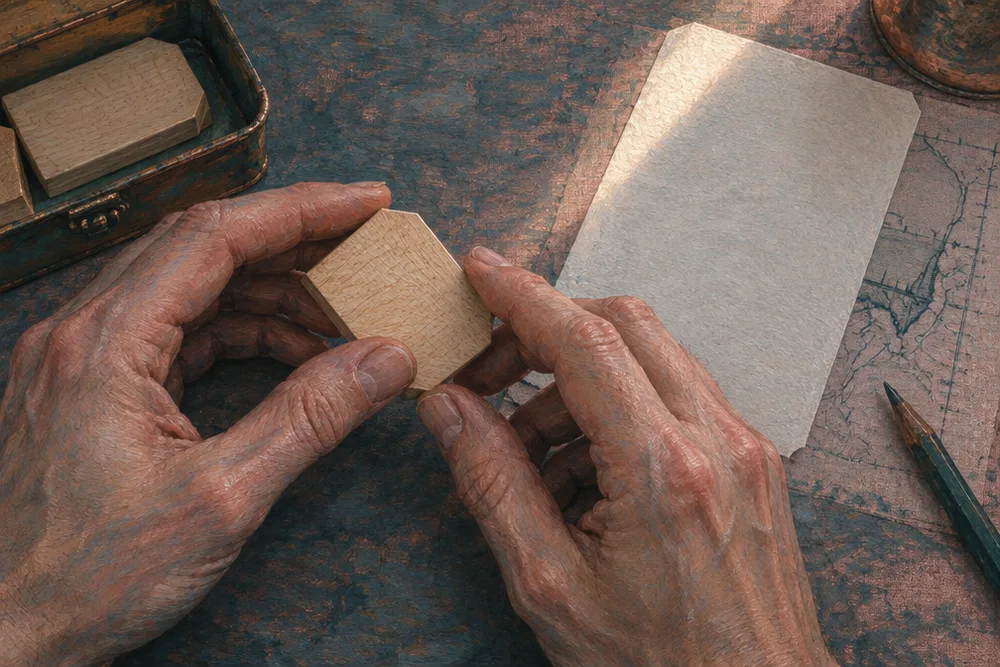
He turned the paper over. A little square of spare stock lay in the tin, one corner already clipped. He took it out and rolled it between his fingers. The board was pearwood, pale and close-grained. Someone had used a knife to shave one end flat. He could cut a mark into it, though he had never made a print in his life.
At the shelter’s open side, the harbor moved through its gray evening colors. Gethin thought of the graders stepping down. Pell had tested each board with his cane; the others had trusted the boat and the man steering it. Trust was not a measurement. It was what you did when you had no better information.
He pulled his knife from his pocket and cut a shallow notch across the wood. Then, after turning the block in his hand, he shaved one edge into a slope. It was a poor little thing, rough where the blade had caught. It could stand for a tread that vanished under water, but only if she guessed what he meant. He almost put it away.
Instead he laid it on the paper beside the drawn step. He was not sure whether she would think it a correction, a signature, or some private bit of nonsense. A proper survey mark needed a scale and a legend. This had neither.
The tin was not there yet when he left the block on the page. He had brought it with him now, a small gray box with a spring lid, its corner crushed from being wedged behind the clock weight. He set the notes inside, then hesitated. Paper could not stay bare in the damp. He opened the tin and fitted the folded sheets beneath its lip.
The lid snapped shut with a dry little click. It was a sound out of place in the Salt Shelf, where everything else whispered or dripped. Gethin pressed the tin between the stone and the clock weight. The crushed corner held fast. He tugged once to test it, then again harder. It stayed wedged.
He knew the tin would be useful. The survey papers could wait there between shifts, and the shelf was dry enough to keep them from curling. He also knew a tin was a small imposition. It asked whoever came next to open it, to look at what had been left, to answer or not. He could tell himself this was only a way of preserving paper. He had made a habit of telling himself that favors were merely practical.