The Tide Between Our Lines
Page 119 of 216
Chapters
They moved the proof to the table and stood on opposite sides of it. Xanthe drew a short line at the last intact rivet head, then a second at the place where the private doorstep had shifted against the public walk.
“If we call the first section open, readers may assume it stays open,” she said. “If we call it passable at low water, that still needs a date.”
“And an observation time.”
“You want the tide time on the sheet?”
“I want to know when somebody checked it.”
She wrote a note in the margin. “A status panel, dated and timed. Public landing to last sound rivet: passable under the listed conditions. Private approach beyond: closed until repair and inspection.”
“Good.”
“You haven’t heard the whole thing. The map line can’t end at the boundary. It has to show where the route continues, or people will think the landing is the destination.”
“A dashed continuation?”
“A broken band. With the words, not a symbol alone.” She glanced at him. “You said readers might not know what the band means.”
“They might not.”
“Then the words have to do the work.”
She made a new mark in the margin. The pencil moved fast now, though she paused to check the fit of every phrase. He watched her build the distinction rather than erase the route. The map would admit that a crossing continued, and also that it could not be used. It seemed a simple thing to ask of a sheet. It was not simple to make the line tell the truth without turning the truth into a warning against every path in the harbor.
“I’d like to check the boundaries in place,” she said. “Not from here.”
“All right.”
“Now, while the tide’s coming in?”
“If we want to see what the conditions do.”
She put the pencil down and reached for her jacket. “Then we walk it.”
Outside, the air had the cold salt bite that made the harbor feel closer than the town behind it. Xanthe carried the proof rolled loosely in one hand, protecting the damp face from the wind. Gethin walked beside her, his stride longer; he shortened it without thinking when the stones narrowed.
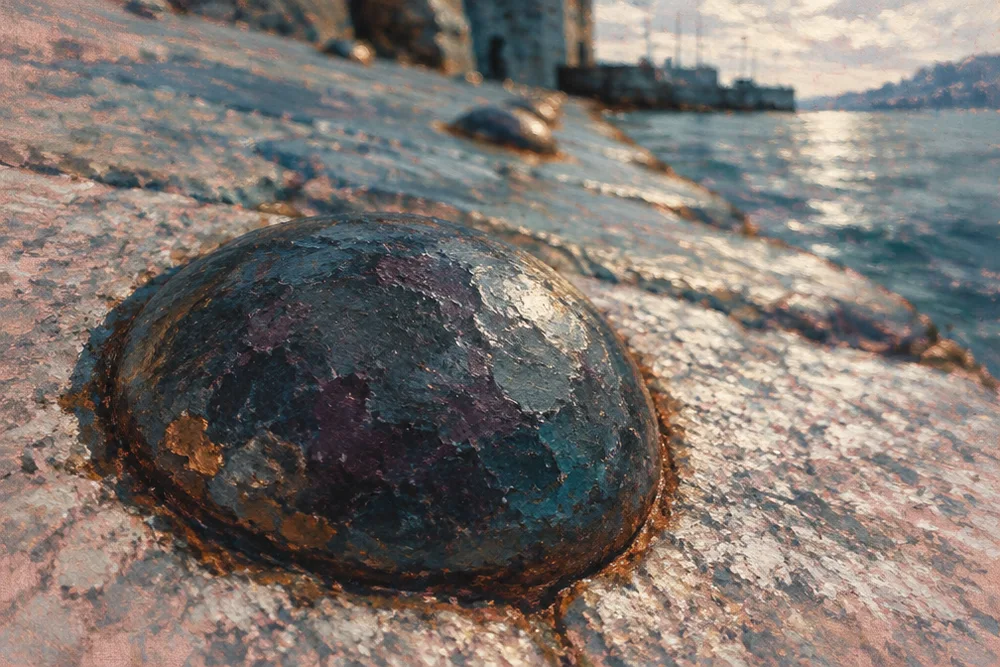
At the public landing, he showed her the first rivet head. At low tide the old iron sat just above the weed line, a dark round mark set into pale stone. A few paces on, the path widened enough for two people to pass. Near the spur, the rivets grew uneven and the stone pinched inward.