The Street That Only Returns
Chapter 7 · The Dry Wick Lamp
Page 62 of 198
Chapters
The stair began where the rusted railing ended, as if it had been waiting behind the turn of Nella’s shoulder. Its first steps were narrow slabs of dark stone, slick with a sheen that was not quite water. Below, the drowned street ran between houses whose upper windows looked level with the seawall. Amber light showed in a handful of them, wavering behind glass. The rest were black, their doorways full of the tide’s dim, reversed glow.
Bess Rusk stood at the top with one hand gripping the rail. Her indigo oilskins made a blunt, solid shape against the flat gray noon. She had come because Nella brought her the dispatch duplicate, because the old grid on it put the drowned houses under the relocated beacons, and because Bess had spent too many years trusting a harbor map that had been redrawn without explanation. Still, looking down, she did not move.
“It’s sound,” Nella said. “I’ve been down.”
“That isn’t what I’m asking.” Bess’s broad nose wrinkled. “How far?”
“Far enough to find my mother’s kitchen.” Nella tightened her grip on the oil jar. It had grown warm against her hip since the flame caught. “And the house under the outer beacon.”
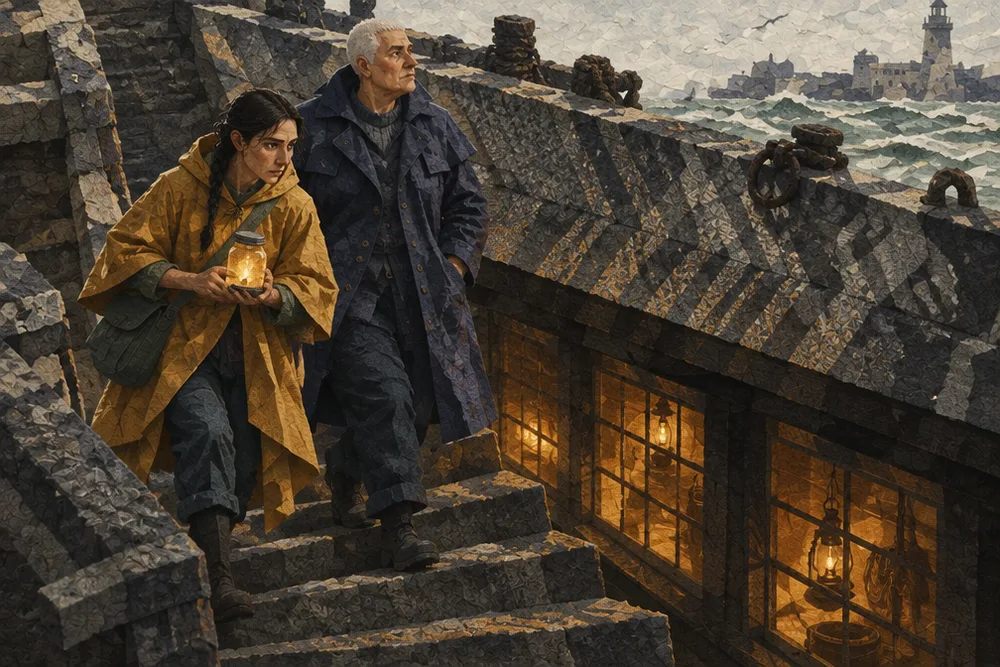
Bess’s chin lifted, the way it did when she was giving an order to a landing crew. “You said a boy lived there.”
“Tavi. Ivo’s son.” Nella looked down at the steps. A current seemed to breathe through the spaces between them, carrying up the smell of wet brick and cold ashes. “I don’t know if he’ll speak to you.”
“Then he won’t.” Bess stepped onto the first slab. “But if that house is under my beacon, I’ll see it with my own eyes.”
Nella went ahead. The jar knocked softly against her thigh. Behind them, the daylight at the top of the stair flattened into a pale strip; ahead, the street’s amber windows took shape one by one. The steps descended farther than the height of the wall allowed. Nella had stopped trying to measure that fact. She watched for loose stone, for slick patches, for any sign the way down might be closing.
At the bottom, the paving was dry. It had the uneven, worn softness of a street walked for generations, though its edges vanished into a tide that pressed against the houses without moving. Nella heard the sea beyond the walls, muffled and continuous, and beneath it a quieter sound: spoons, a chair scraped, a door shut somewhere far along the row.