The Street That Only Returns
Page 23 of 198
Chapters
Nella went to the window. At first she saw only the black glass, then the street beyond emerged in separate pieces: a low roof, a slant of masonry, the empty windows of the nearest house. The water did not ripple. It pressed against the buildings without a visible surface, as if the whole street had been submerged in ink.
A pale patch showed at the far end of the lane. It might have been a door or a torn square of sky. Beyond it, the seawall’s underside made a heavy shadow. She could not see the stair from here.
“How long?” she asked.
“Until morning, if the oil lasts.”
“And what happens then?”
“The water comes back.”
“To you?”
Orma looked over. “To the street.”
The distinction felt like a trick. Nella had spent eleven years learning that a flood could be made into a number: the inches over the sill, the hour the tide turned, the bags of sand used at the pump house. But here water meant the absence of a place. It meant this window going black and the lane disappearing beneath her feet.
“You said you didn’t know how this works.”
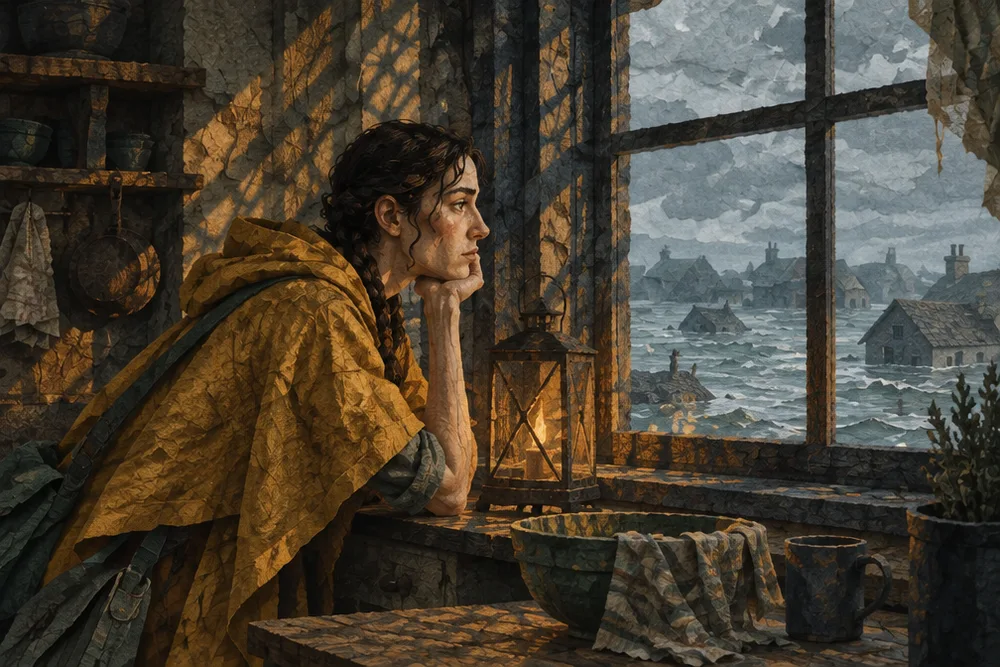
“I don’t know why it’s this way. I know what happens when the flame dies.” Orma’s mouth tightened, and she rubbed a thumb over the edge of her apron. “It happened once already.”
Nella remembered her mother’s hands sorting beans in a bowl, thick wrists, small cuts from kitchen work. She remembered the flood morning less as a sequence than as flashes: the door shuddering, cold water climbing the stair, Orma telling her to run uphill. A scar crossed Nella’s left palm. She had got it that morning on a broken window latch. She curled her fingers into her hand.
“You could have told me,” Nella said.
“You were upstairs.”
“For eleven years.”
Orma’s gaze lowered to the table. “Yes.”
The single word carried no defense. It left Nella with nothing to push against but the wall itself.
The jar stood beside the hearth, its dark contents barely visible. Nella thought of the living town above: the pump house, the three beacons along the channel, the ferry office with its notice pinned for the final inbound passage. She thought of Ivo’s expression when he handed her the jar, his careful refusal to name a recipient.
“Where does this oil come from?” she asked.
“Ask Ivo.” Orma’s eyes returned to hers. “Ask him what he takes for it.”