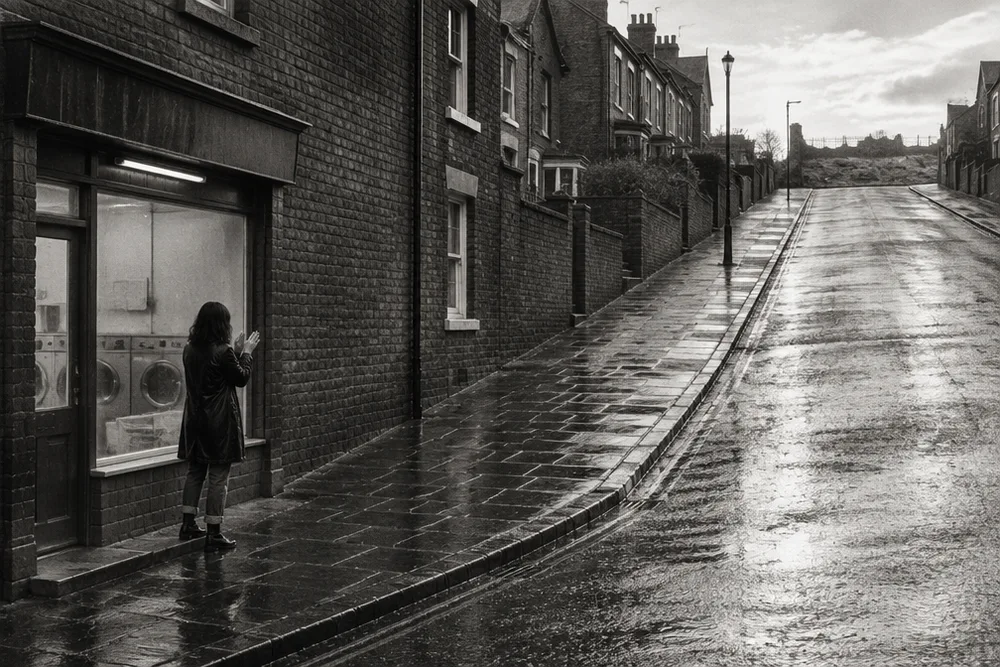
The Silence Under Bell Street
Page 21 of 303
Chapters
She took the lantern and went to the rear door. A red patch showed where someone had painted over an old warning sign. The knob turned, then stopped. The door had swollen in the frame. Kit leaned her shoulder against it until the wood gave a small groan and opened a few inches.
A cold draft brushed her knuckles.
Beyond the door, the stairs fell away in a narrow strip. The lantern picked out chipped paint, a damp iron rail, and the edge of the first step. Somewhere below, a chair scraped once, then stopped.
Kit did not go down. She held the door open and waited, counting the seconds. The usual return did not come. The sound seemed to have moved farther from the cellar, farther from the house, farther than a room could hold. She felt the old impulse to follow it and name its location. That was what she had always done. Locate the sound. Mark the point. Make the invisible thing manageable.
The bell over the front door rang in the street wind. Kit shut the cellar door.
The next day, she brought the squared paper to the hatch and drew the shop’s outline from memory. The front windows faced the street; the stairs were at the rear left; the hatch sat between the machines and the folding counter. She marked the tiled floor in pencil, then the drain line, then the probable position of the old cellar wall from the council plan.
It was a rough sketch, but the distances mattered. Kit had never been comfortable with a sound she could not place. When the council assigned her to a building, she began by walking the perimeter and recording its dimensions. Then she clapped in three different locations, timing the returns on a stopwatch. Each landing gave her a slightly different answer. In a room with a clean wall, the sound came back in a fraction of a second. In a corridor, it stretched. In a cavity, it could come from a place the map did not show.
She had taught herself to hear those differences by repeating the tests until the numbers made sense. Her colleagues had called it patience. Kit thought of it as refusal: the refusal to accept that a noise could be everywhere and nowhere at once.
She took the clap test outside, standing on the shop step. The rain had stopped. Bell Street shone darkly, its slope running up toward the old school site. A brick wall rose beside the laundrette, wet mortar dark between the bricks. She clapped once and watched the sound leave her hands.