The Silence Under Bell Street
Page 2 of 303
Chapters
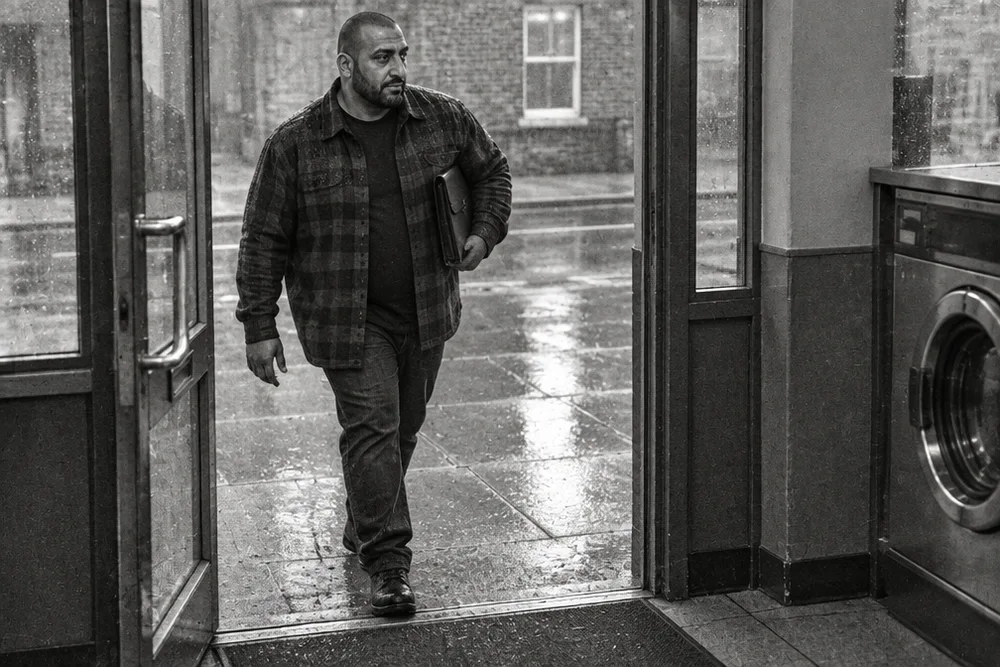
At seven and four, the chalk squeaked again. Kit went to switch on the fluorescent strip over the folding table. Light showed the clean rows of washers, the plastic chairs, the hand-lettered sign about pockets and loose coins. Nothing in the picture admitted that a child had just written something on a board below her feet.
Her sale papers waited in the little office. Friday: signatures, transfer, keys. The buyer had promised a fair price, and Kit had used her share of the deposit to put down a holding payment on a room across town. A new job began the following week, one that would not require her to walk past the burned school’s foundations each morning. She had arranged it so neatly that the shape of escape could almost be mistaken for a future.
At seven and ten, the shop bell rang. Dev Sarwankar came in with rain beaded on his checked overshirt and a document wallet tucked beneath his arm. He was a heavyset man who seemed to hunch over every piece of paper he read, as though the words were printed low on the page. His neat beard was dark with rain at the chin.
“You’re early,” Kit said.
“I wanted to catch you before the first customers.” He glanced at the machines. “Or are there customers now?”
She looked at him. “What does that mean?”
“Nothing.” He rubbed his palms together, then took out a folded plan. He had the apologetic expression of someone who had already decided that the thing he was about to say was reasonable. “I’ve been through the cellar layout again. The concrete crew can do the fill after completion. It makes the drainage simple, and it gives me a proper level base for the conversion.”
Kit’s gaze moved to the hatch. “You’re filling the cellar?”
“Not the whole thing, not in the way you’re imagining. We’ll clear the loose brick and put in a reinforced fill, tied into the floor. The survey says the ground’s unstable where the old culvert crosses under the building.” He unfolded the plan on the folding table, keeping one palm on a corner so it would not curl. “It’s a sensible precaution.”
The old school had stood uphill, across the terrace, before it burned. The rain culvert ran beneath Bell Street and crossed the school’s footprint on its way down toward the river. The laundrette was built over the line of it. Kit knew the route because the council had sent her to investigate complaints about a hollow sound beneath the pavement. She knew the cellar’s far wall was older than the shop, its bricks blackened in patches where damp had worked through the mortar.