The Seams Beneath the Tide
Page 274 of 277
Chapters
On her way back, she passed the clock shop. The owner had propped the door open, and a row of clocks on the wall ticked at different speeds. Greta stopped to look. None of them agreed with the others, yet all kept time well enough for someone to catch a train or open a shop. She smiled at the thought, then continued to the workshop before Vale could say she was late.
The bench was ready for delivery. Greta pressed the velvet smooth with the flat of her palm, then tested the lining flap. It opened cleanly. Beneath it, the frame was visible, ordinary timber with a pencil mark and a small nick where a tack had been removed. She fastened the flap again without forcing it shut. The work was finished, but not sealed against the work that might come after.
Gwenna’s reply took nine days. Greta recognized the handwriting before she had removed her apron. Inside was a sheet covered on both sides, and a small strip of gray cotton folded into the crease. It was not a name tape. Gwenna had written on it in blue ink: flour, 1978. “This came from a sack in the loft,” she explained. “I am sending it because I thought you might know what it was for. I do not. It is not from a coat.”
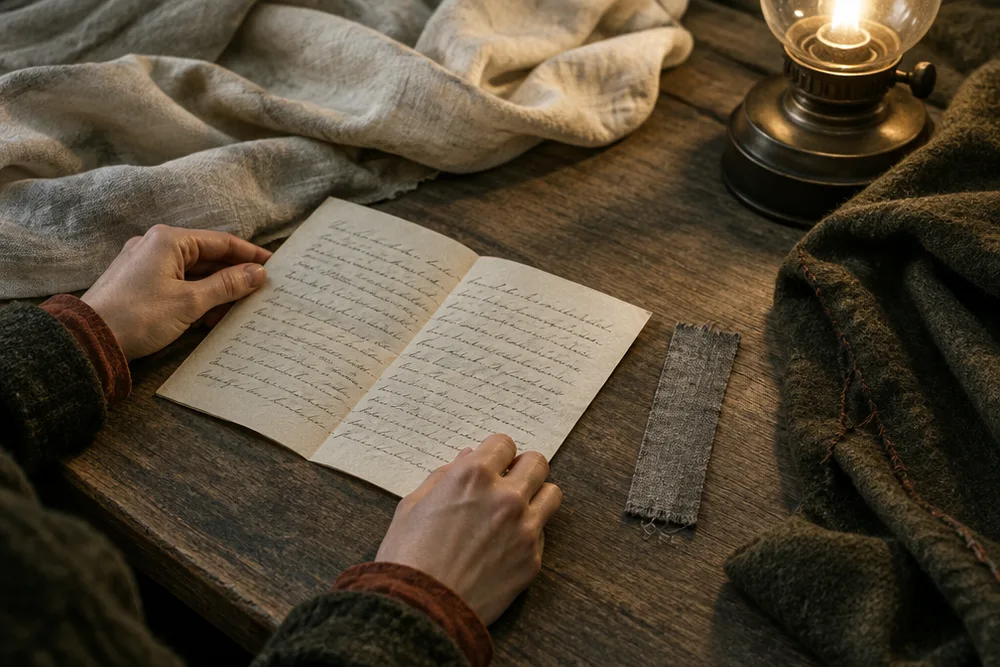
The letter began with Tavis. Gwenna remembered him trying to mend a chair with a tool that was too large for the screw. He had insisted the chair was the problem, not the tool. Then he had sat down on it to demonstrate and made the loose rung fall out. “He laughed before I did,” she wrote, “and then he went to find the right screwdriver.” She remembered his impatience and his willingness to admit when he had made a thing worse.
The detail was not a correction of Greta’s parcel, or a denial that he had been kind. It gave him another shape: a man laughing at a chair he had broken, fetching the correct tool, and leaving Gwenna to decide whether the joke was worth telling. Greta read the memory aloud once, quietly, in her room. Nothing in the walls answered. The silence did not certify the story. It was simply the room holding a voice she had chosen to use.
She set the strip on her palm and turned it over. The ink had faded but remained legible. She could not remember the flour sack or the year, but she liked that Gwenna had sent something ordinary rather than a keepsake. The strip had no dead person’s name sewn into it. It was a scrap from work, saved by accident or habit, given freely now.