The Seams Beneath the Tide
Page 277 of 277
Chapters
Greta’s letters and Gwenna’s crossed the distance between them. They did not always arrive quickly, and neither woman wrote every week. When they did, they offered details rather than conclusions: a customer who had argued over a hem, a chair rung that had finally been repaired, a rainstorm that had left the stair lane slick. Sometimes one of them mentioned Tavis. Sometimes the letters contained no mention of him at all.
Greta kept the words about the parcel and the chair in the same drawer. They did not match perfectly, and they did not have to. She could picture Tavis’s hands with the twine and Gwenna’s account of his mistake at the chair. The man in the photograph remained still, knees wide, his face fixed in a moment neither memory could complete. Greta could love what she remembered without making it evidence in a case against the sea.
At the workshop she finished another lining with a service opening. She tested its fastenings, wrote the repair method in the ledger, and left the flap ready for the next person. The foreman asked her to show the design to the others. Greta did. She spoke plainly, answered their questions, then returned to her bench and set a fresh length of cloth beneath the needle.
She did not know whether the clothes had carried the dead, or only the sounds of people who had once touched them. She did not know whether the thing that answered from Tavis’s oilskin had begun in his voice or in someone else’s grief. The work at the laundry had not resolved those questions. It had changed what the village was willing to do while the questions remained.
Families could keep a garment without being made to prove the voice inside it. They could keep a patch, a button, a written record, or nothing. Gwenna could remember her son-in-law without guarding his coat. Iona could love Linn without allowing a stranger—or a garment—to turn her child into a lesson. Greta could carry one small memory across the water and leave another unclaimed.
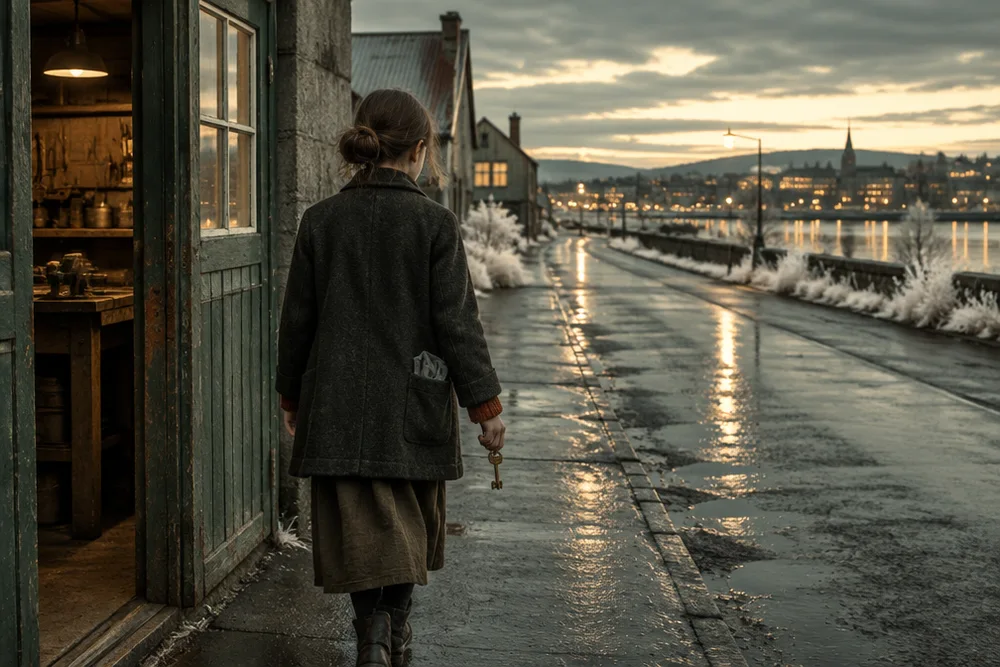
At the end of her shift, she closed the workshop door and checked the fastening on the bench lining once more. It stayed shut under a light touch and opened when she lifted the edge. Outside, the rain had stopped. She walked home without hurrying, her hands empty except for the key and the folded scrap of gray cotton in her pocket. When a door banged somewhere behind her, she turned, saw no one in the street, and kept walking.