The Rope Bridge in the Orchard Wall
Chapter 6 · The Door Drawn Backward
Page 55 of 224
Chapters
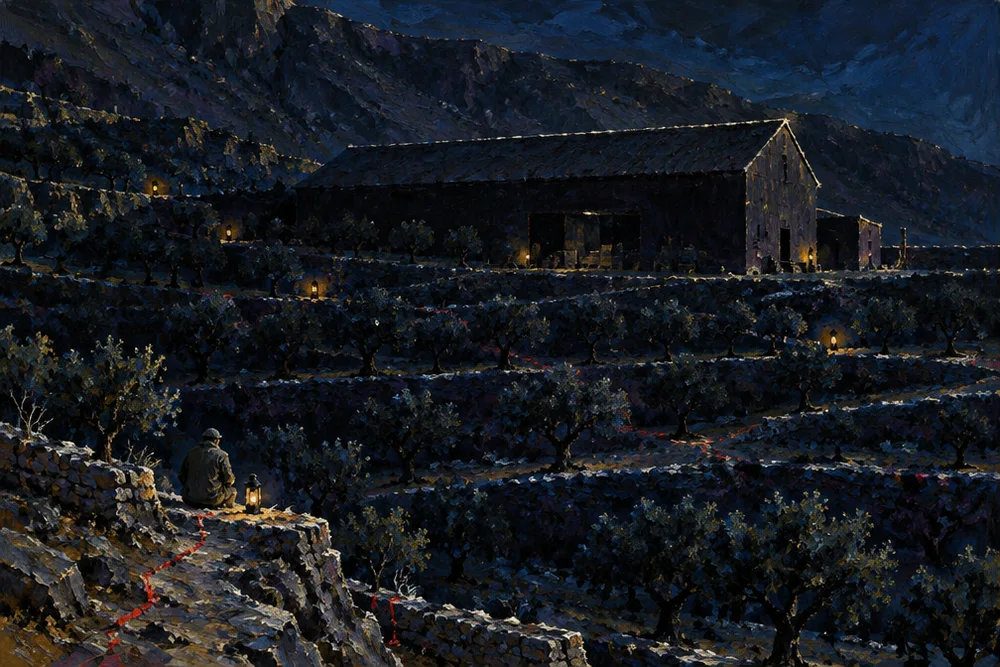
The terraces disappeared one by one when night came down. From the goat shelf, Perrin could still make out the nearest orchard wall as a pale line, and beyond it the dark bulk of the packing shed. He held the lantern low, hooding its flame with his palm whenever the wind pushed at it.
Below, water muttered where the stream had once run clear. The slide had dammed it somewhere out of sight, and the backed-up water was climbing toward Ternhook’s lower houses. Perrin knew this because people kept saying so. He also knew the words didn’t tell him which path still held firm.
He set his paper on a flat stone and began drawing the shed from this side. Its long roof sloped away from him. A narrow ledge ran beneath the wall, though he couldn’t tell whether it joined the upper terrace or ended above a drop. He put in the dark rectangle of the door, then the uneven bars of boards across it.
The boards mattered. Sella had sent him to see the shed’s outside, and she needed to know if the ridge door was truly boarded shut. Dova had refused the key, insisting the door was useless. Perrin did not like a drawing that merely repeated what someone had said.
He shifted his weight, and the goat shelf ground softly under one heel. It was dry here, a small shoulder of rock above the orchard, but the terraces below were hidden in blackness. Perrin kept his eyes on the shed and worked by lantern light, swiveling from the hips as he compared each line with the shape in front of him.
At the edge of the paper he drew the corner of the roof, the side wall, and the path that disappeared behind it. He marked the door with a small cross. Then he marked the boards, counting them as carefully as he could through the wavering flame.
“If you’re going to fall,” Sella had told him before he left, “fall on the page. I can’t carry you and your sketch.”
Perrin had said he wouldn’t fall. Now he was less sure about the sketch.
He lowered the lantern to check the lines. Seen close, they looked wrong. The door was on the side wall, not at the end where the path seemed to lead. He’d drawn the boards as if they filled a doorway facing the ridge, but the shed’s roofline and corner said otherwise.