The Rope Bridge in the Orchard Wall
Page 19 of 224
Chapters
When the count reached the upper landing, they found the woman’s youngest child asleep against her shoulder. She gave the name in a whisper. Perrin wrote it carefully, then drew a short line underneath the family’s four names.
“That’s everyone here?” Ivo asked.
“Everyone we can find,” Perrin said. He folded the paper so the list would fit inside his apron pocket, then unfolded it again. “No. We should keep it open.”
Outside, the stream’s backwater had spread across the lower lane. It was not a flood rushing downhill; it was a slow, deliberate occupation. Water pressed through gaps between houses and lifted a wood chip that drifted toward the stone well. The road was buried, the stream had been dammed, and the village’s familiar ways out had become walls of water or falling rock.
The club carried blankets and the revised count uphill toward the orchard. They did not have a confirmed route beyond it. Dova said the high sorting barn would shelter people until they knew more. Sella checked the bindings on a stack of ash ladders as they passed the tool shed, counting their rungs with a thumb that moved fast and sure.
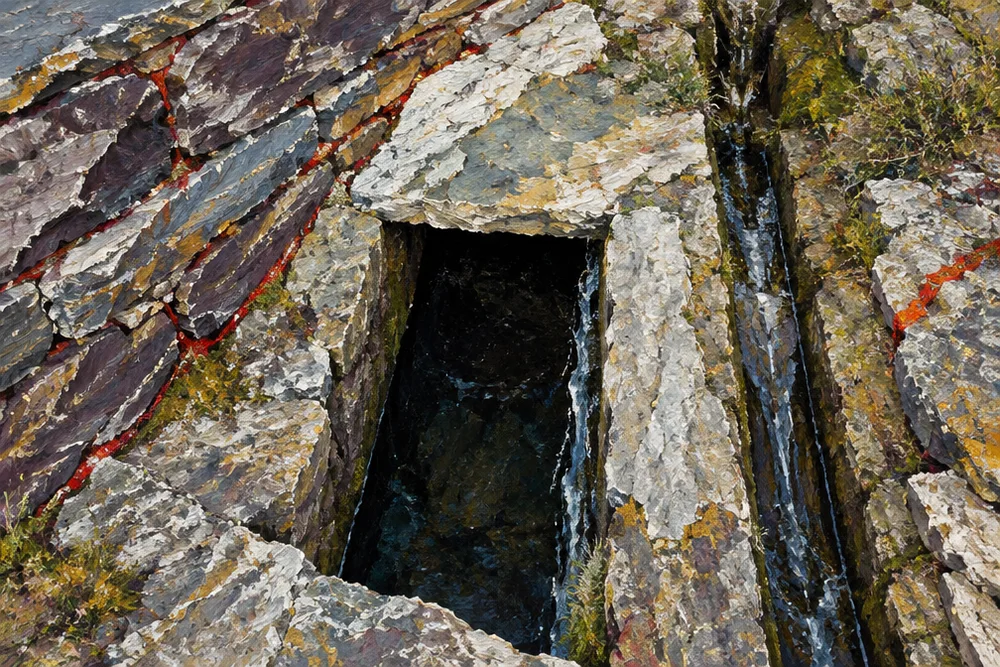
Ivo lagged behind at the drying house, staring at a narrow drain cut into the stone at the foot of the wall. It had been carved in the shape of a pear stem, a shallow groove with a hook at one end. Anet had drawn a similar mark in her folio. He had assumed it was a decorative flourish on the edge of a sketch.
He crouched and brushed away grit. The drain ran behind the house, toward the orchard wall. Even with water pooled around it, the line of the cut was clear. He took out the folio, careful to keep its pages above the damp stone. The water stain on one corner had darkened since morning.
“Ivo!” Sella called from uphill.
“Coming.” He kept the folio open. A small sketch showed the pear-stem mark beside a blank strip of paper.
The folio’s page was crowded with Anet’s graphite lines: a section of wall, a narrow opening, then the pear-stem symbol. The drawing had no labels. Ivo traced the groove with a finger without touching the paper. Anet’s hand had put the mark just where the drain would begin to turn behind the drying house.
He took a length of string from his pocket and held it against the direction of the carved channel. It led toward the orchard, where the high wall ran above the stream and the lower houses. The Tooth Wall stood farther up the shelf, a boundary of pale stone with a gap over the old intake slot. Ivo had heard the story of the basket bridge there: once used to carry fruit across to a maintenance ledge, never anything heavier.