The River Has Another Door
Page 79 of 230
Chapters
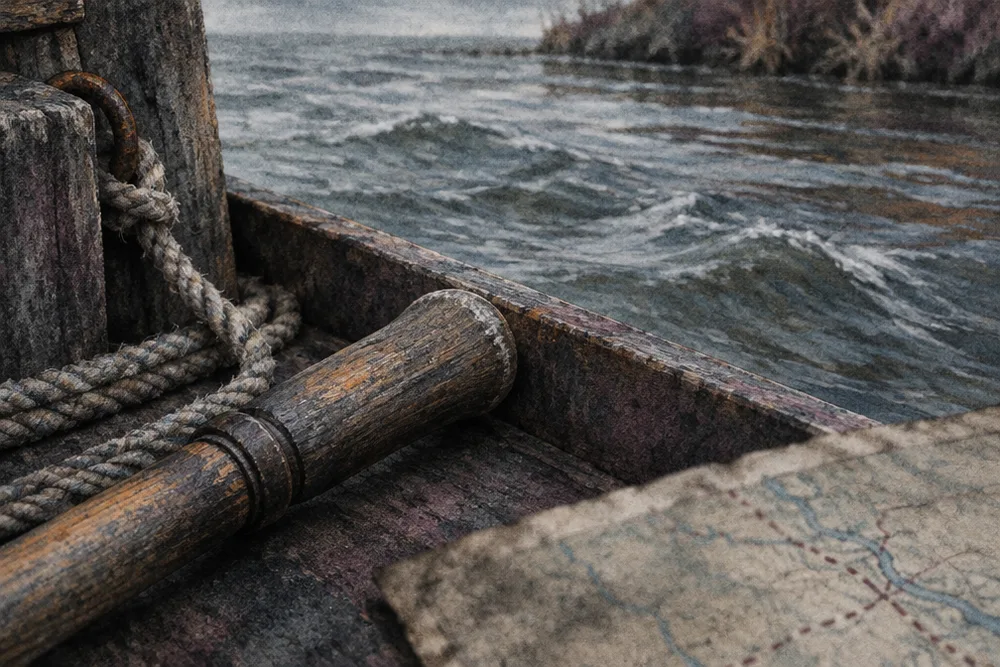
I took the painter again while she hauled the punt back into the cradle. My palms stung where the rope had dragged. The short oar looked less like a tool than a promise made by somebody who had never tried to steer here.
“Could we use a longer one?” I asked.
“We could use a longer arm, too. Or a river that listens.” Doro wiped her hands on her coveralls. “The oar isn’t the whole problem. This boat used to run on a guide.”
She said it as if I ought to know. I opened the map case.
“Upstream?” I asked.
“Upstream.” She pointed along the bank, past the landing and the low roofs of the town. “The old ferry didn’t aim straight across. It took the slack water above the bend, crossed on the guide, then let the current carry it down to Notch.”
“Where is the guide now?”
“Some of it is under silt. Some of it is still bolted to things nobody notices.” Doro closed her tool roll. “I can show you the mounts. I can’t make them whole by pointing.”
The river shifted under the punt. Its bow knocked the cradle once, lightly. I looked at the worn route on my map and saw that the faded line wasn’t a mistake. It was the part everyone had stopped using.
We followed the bank upstream, carrying the map between us so the wind wouldn’t fold it shut. Doro walked with one hip braced when she stopped to look at something. I had to keep bending my knees to match her pace, because she moved quickly and never seemed to waste a step.
The first mounting was a rusted iron loop set low in a stone post. A second stood across the river, nearly hidden in the reeds. Between them the water ran smoother, protected by the bend. I crouched beside the first and scraped away mud with my thumb. A round socket showed beneath the rust.
“There,” Doro said. “A guide rope ran through. The punt could angle against it instead of asking that little oar to fight the whole river.”
“And the other end?”
“Further up. We’ll have to find it.” She tapped the map where the faded line crossed. “This was built to carry freight and people. Not just to make a dramatic entrance.”
I looked over the water. The route’s old logic was plain once I knew where to look: travel with the current, then cross where the river loosened its grip. It was a practical thing. That made it more unsettling, somehow, that Bell Reach had let it vanish.