The River Has Another Door
Page 67 of 230
Chapters
“My mum drives the late bus,” Leda said. “I meant she could get you back if the boat didn't run. The bus doesn't come here, but it stops at the fork. You can walk down.”
“How far?”
“From the fork? Ten minutes, maybe fifteen.”
“With what in my hands?”
Leda looked down at the glass. A brown crescent had begun to print through the damp on her jacket. The last stretch below the fork was steep enough that she'd kept a hand on the retaining wall coming down, and she'd had both hands free.
“Not with this,” she said.
“I'd manage with that. Try two boxes of fittings that both say KEEP DRY.”
“You could leave them until—” Leda stopped. There wasn't an end to the sentence that didn't require Doro to make another trip.
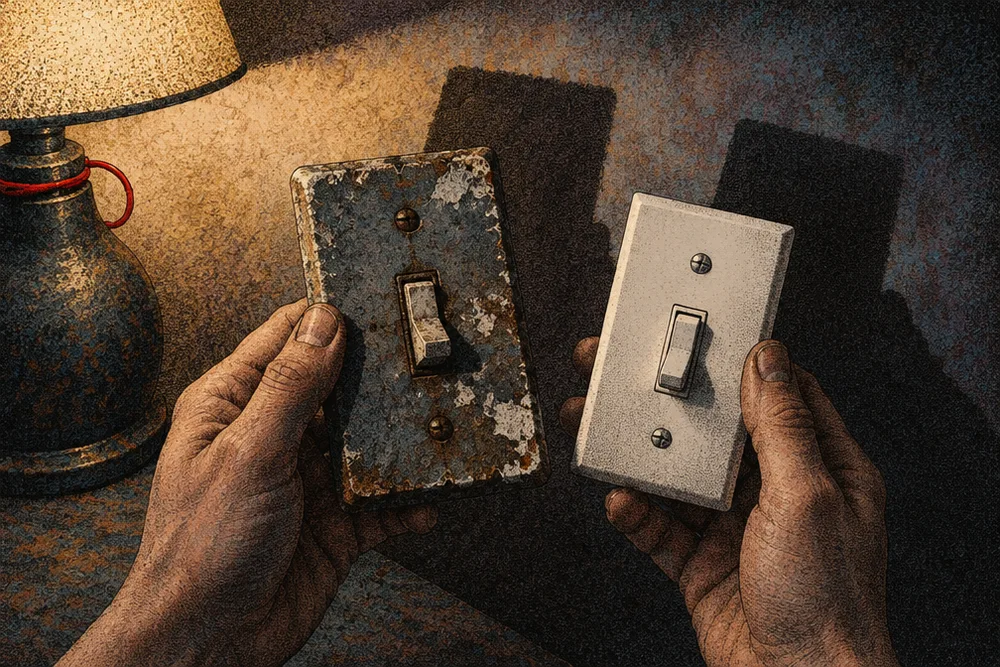
Doro slid the old switch out of its housing. The back was clean. The front had a thumb-shaped hollow worn into it. She set it on the wall, well back from the edge.
“Anyway,” she said, “if the boat isn't running because the river's up, what makes you think your mother's bus will be running?”
Leda had no answer for that. She'd been saving the bus for herself in exactly the same way.
“Tell me when you'd put the bus on the list,” Doro said.
The question took a moment to make sense. “What list?”
“The one that says how I'm getting back. If you put the bus on it, when do you know you can put it there?”
Leda thought of Mara on an early shift, coat still on in the kitchen, waiting for the call from whoever had gone out to read the pegs. People would be down at the shelter with their collars up before the depot made the decision. Sometimes the decision was to send the bus as far as the water and let people see the reason for themselves.
“Not when you leave here,” she said. “Later than that.”
Doro nodded toward a clean fold in the rag lying next to the tool roll. Leda set the glass on it. The absence of the weight made her hands feel clumsy. She wiped them on the sides of her shorts and got out her notebook.
The bus times were inside the front cover. Six was boxed once in pencil and again in ink, as if it might otherwise get out. She'd drawn a line from the bus to the station, from the station to the train, and from the train to the building where someone would listen to what she'd made. She'd even written down the time it took to get from the station platform to the ticket machine. Four minutes if nobody wanted to ask the machine a question.