The Return Address Is Tomorrow
Chapter 22 · The Address That Answers
Page 265 of 276
Chapters
The dry interval came with a mail sack and a boy who had mistaken a condemned doorway for a delivery point. He stood at Ropewalk Street’s old entrance, boots planted on the dry strip above the tide stain, and held out a stack of envelopes as if the building might still answer for them.
Nera saw him from the working punt. The boat was tied beneath the upper decks, its black hull rocking against the night mooring while morning light showed through the open water lanes. Her delivery book lay on her knees, its swollen pages still ridged from the flood. She closed it and climbed ashore.
“Ropewalk Street?” the courier asked. He was new enough to wear his bag high on his chest and old enough to know not to step past the barrier. A bone-white condemnation notice covered the entrance. The lower windows behind it were boarded, their boards dark at the edges where the water had dried.
“That address is finished,” Nera said. “The people aren’t.” She held out her hand for the letters. “Who gave you the book you’re following?”
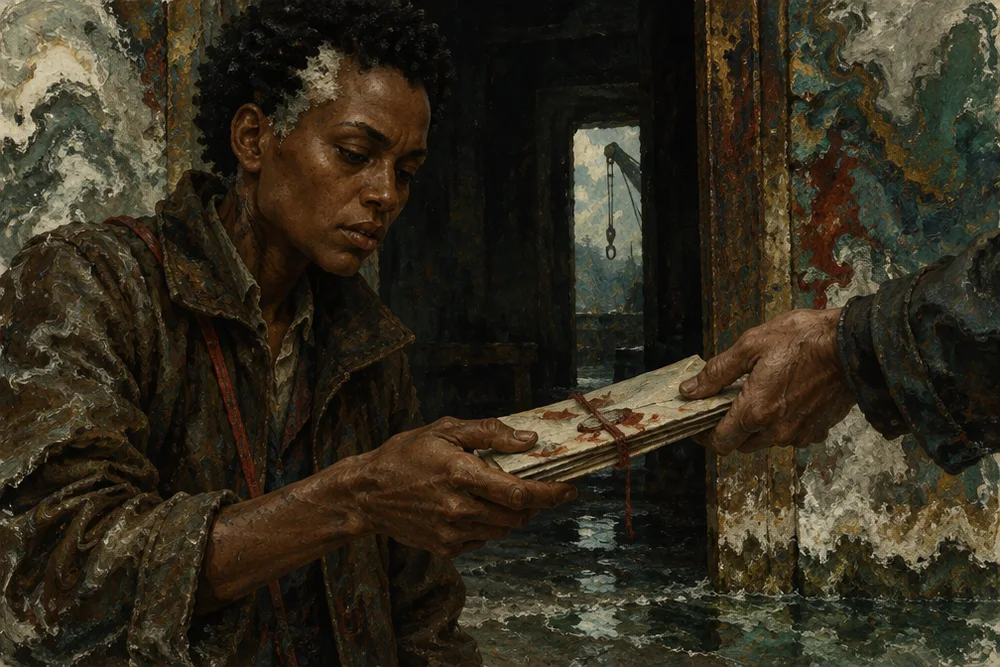
“Dispatch desk. It’s in the route ledger.” The boy glanced down at the envelopes, then at her red receipt cord. “I was told to leave these at the old stair.”
“You were told wrong. Don’t leave mail where nobody can collect it.” Nera sorted the stack by the names she recognized, then stopped. The names on the envelopes belonged to people who had changed landings twice since the flood. One was addressed to a family now sleeping aboard the punt; another to a woman who had never used her surname on a public list.
“I can take them,” she said. “But next time you ask where the address is now.” The boy looked relieved, though he tried to hide it. Nera slipped the letters into the dry inside pocket of her oilskin and turned toward the water stair. The city’s old street had become a destination without a door. She would have to find out what its residents wanted written in its place.
The working boat’s route had no fixed stop at the old street. It ran between occupied stairs, Tin Apron and the upper decks, carrying parcels, repair crews and whoever had paid a fare. Its berth receipt hung in a tin sleeve by the cabin hook, the numbered clip visible through the cloudy cover. Nera could have delivered the letters by asking around. She could not make that a route anyone else could repeat.