The Return Address Is Tomorrow
Page 229 of 276
Chapters
They worked through the book on the upper landing while the punt strained lightly at its line. Tali knew which households had gone to the loft, which had cousins on the upper decks, and which names were still missing from the night muster. Nera marked each with a short stroke, refusing to convert the marks into a headcount. The names weren’t fares. They were people who might need a way to reach a clinic, a job, a dry place to collect a week’s pay.
“The Rull boys have a berth with their aunt,” Tali said. “They’ll still need to get back for the tools they left.”
“Tools can ride.”
“Not if you charge them like a crate.”
Nera made a second mark beside the names. “Then they don’t go in the freight column.”
Tali watched her write. “A route can turn into a list very quickly.”
“I know.” Nera closed the book. “That’s why you’ll tell me when I start treating it like one.”
Tali’s mouth tightened, though not with anger. “I’ll tell you when you start treating anything like it belongs to you.” She looked out toward the drowned street, then at the punt. “But I’ll help you find out what people actually need.”
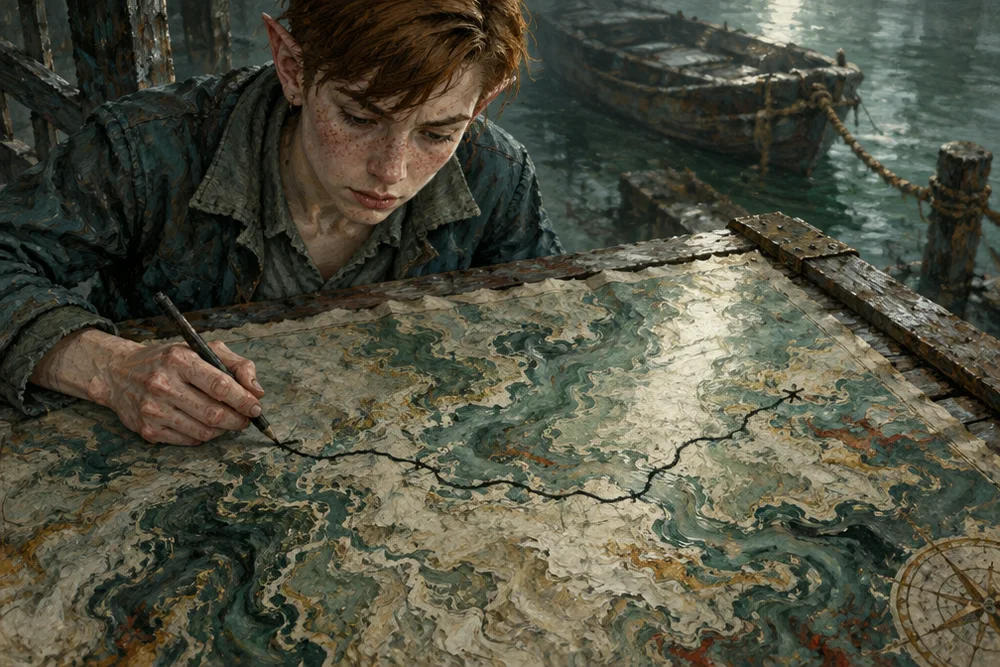
At the upper loft, Siv had pinned a fresh sheet of survey paper to a crate lid. Their fringe fell across one eye as they bent over the marks, slate case open beside them. The map was no longer a picture of Ropewalk as it had been. Siv had drawn the inhabited stairs first: the loft landing, two deck stairs above it, a cookshop stair across the channel, and the narrow approach to Tin Apron. Between them ran a wavering line of soundings taken after the flood.
“You’ve put the old street in gray,” Nera said.
“It’s still there.” Siv kept their pen moving. “It’s just not a dry route. I want the map to say what a person can use, not what the city used to call a street.”
The line they had drawn joined one inhabited stair to another, crossing open water where the old alley had been. At each landing, Siv noted the depth at ordinary daylight tide and the clearance beneath any roof. Small symbols marked places wide enough for the punt to wait, and a narrow slash marked places where it could not turn.
“Could it carry parcels?” Nera asked.
“If the parcels don’t make it ride lower than the second draft mark.” Siv glanced up. “Could it carry repair workers?”
“If they pay a fare.”
“That’s not the same as yes.”