The Return Address Is Tomorrow
Page 146 of 276
Chapters
“That’s the limit of my name,” she said.
“It’s enough,” Nera answered.
Tali glanced at her. “Don’t say that until the water’s up.”
“I won’t.”
Siv arrived at a run, slate case bouncing against their hip. Their auburn fringe had come loose from its neat part and stuck to their forehead. They stopped when they saw the papers, knees locked straight with nerves.
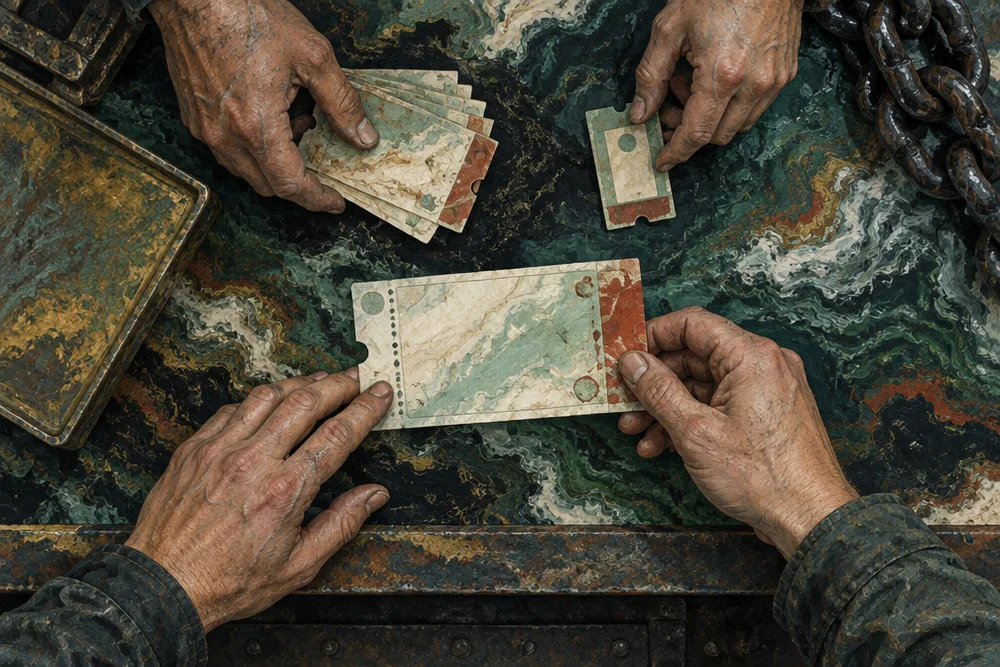
“I need tickets,” Nera said. “Numbered. Tasks and hours, not names or addresses. Can you make a run that doesn’t repeat?”
Siv opened the case and pulled out their slate. “How many?”
“Start with the number of shifts the crews listed.”
They examined the papers, lips moving silently as they counted. “I can cut card from the map backing. It’ll take a few minutes.”
“Make the number visible to the crews and the office.”
“And not tied to the people?”
“Exactly.”
Siv’s shoulders eased a fraction. “Good. A ticket that says what it buys, not where someone sleeps.”
They used the broad end of a packing bench as a table. The foreman set a weight on each corner of the paper to keep the damp air from curling it. Siv cut narrow rectangles from the stiff backing of an old survey sheet, taking care not to cut through any mapped line. On each ticket they wrote a number, a task, and the number of hours it paid. They left a blank square for the crew’s mark when the work was complete.
Iven checked the sequence as the tickets accumulated. “If someone loses one, it can’t be replaced without proof.”
“A proof that names them?” Tali asked.
“No. The number of the lost ticket is enough. We void it and issue a new one.”
“And the old number stays on the void list?”
“Yes.”
“Where?”
“At Clip House, not on the street.”
Tali looked to Nera. “Can the street check what’s void?”
“We can put the numbers on the public copy.” Nera drew two vertical columns on a clean sheet. One for issued tickets, one for voided ones. “No names. Anyone can see if a ticket is still good.”
“And if someone takes a picture?” Siv asked.
“There’s no address to take with it,” Nera said.
Siv nodded, then added the ticket numbers to the public copy. Their ink-black fingertips left small smudges on the paper. The details mattered. A clean number could protect someone from a clerk’s list, but only if it could also be checked by the people whose labor it represented.
The foreman chose the first ticket and read it aloud: two hours clearing haul-out blocks, paid at the agreed rate. “Whoever claims this works with one of my crew. Nobody touches a block alone.”