The Return Address Is Tomorrow
Page 11 of 276
Chapters
“If my street is going under, it is.”
“Your street is not under.” He spoke the words as if he were reading a condition from a form. “Not this morning.”
Nera looked at the empty clip spaces on the wall. She had spent years delivering other people’s parcels to addresses that changed before she arrived. A name stayed in a book long after a person had been moved. A dry berth could be a beginning, or merely a line on a ledger whose holder was waiting to see whether it became inconvenient.
“You promised me a room if I brought the bell back.”
“I promised an assignment after inspection, subject to capacity.”
“You haven’t inspected anything.”
“I’m inspecting it now.”
He took the bell at last, lifting it by its rim. Its body rested in his palm, thumb dent turned outward. His eyes went to the three salt bands. For a moment, he seemed less like a broker than a man reading an old route he had hoped no one would ask him to explain.
“You know what those marks mean,” Nera said.
“I know the bell must be returned before the turn.”
“That’s what you keep saying.”
“Because it matters.”
He set the bell down again. A dry little sound came from its sealed base as the metal met wood. Nera felt, rather than heard, the memory of the note at the post. The unasked question pressed against her ribs: if the bell could call a boat, what had it called through the door?
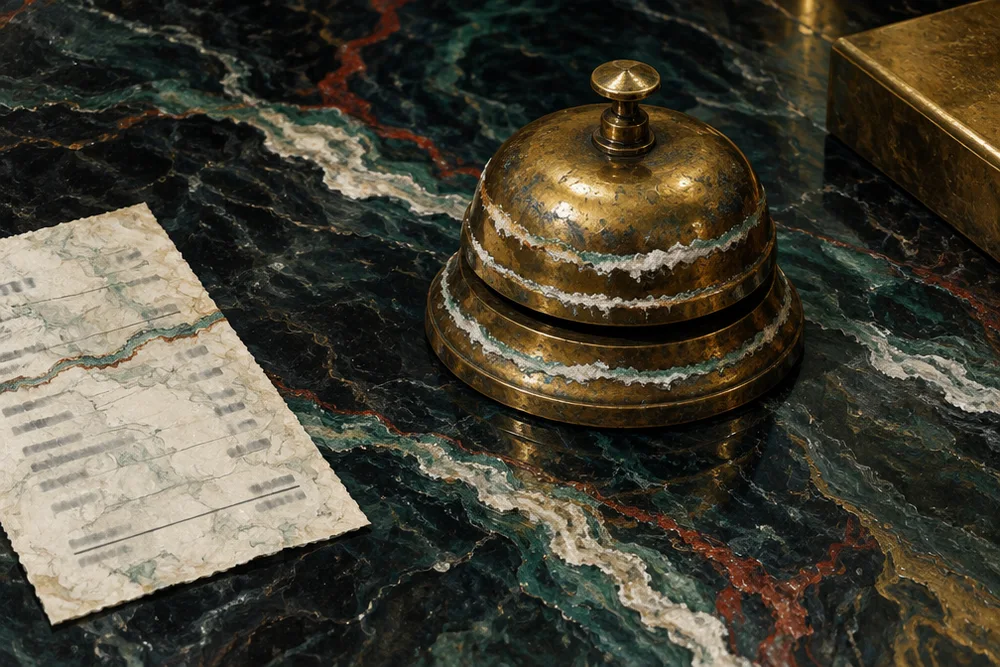
“You said the berth is permanent once assigned,” she said.
“Yes.”
“And you haven’t assigned it.”
“No.”
“Why?”
Iven folded his hands, the bent finger resting on top. “The room must be available. The floor must carry the load. The reservation must be released.”
“Then write that on my receipt.”
“It is already there.”
“Not the part about what happens if it isn’t.”
He looked at her for a long beat, then reached for the paper. In the margin, beneath his earlier condition, he added a sentence: if no berth can be assigned, fee to be settled in payroll credit. He signed his initials beside it.
“That still isn’t a room,” Nera said.
“No,” Iven replied. “It is something you can collect if there isn’t one.”
Nera read the added line twice. Payroll credit would be useful if she could get it; it would not keep her dry tonight. Still, the new sentence had a value. It named a consequence that had not been named before, and gave her something to demand if the room vanished.