The Province Inside the Compass
Page 93 of 212
Chapters
“This is the world outside?” Mara asked.
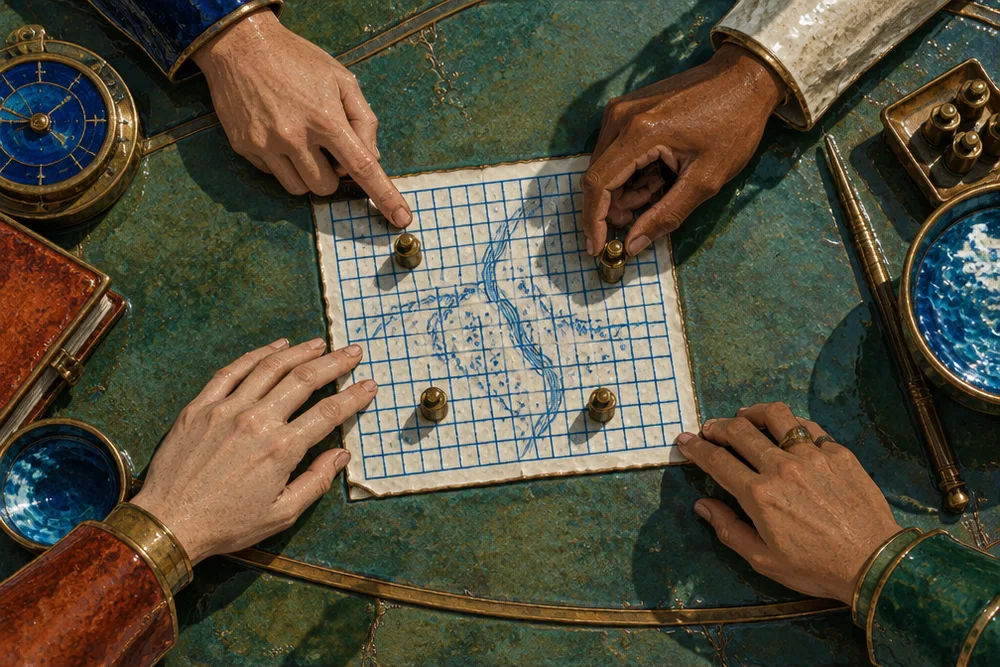
“It is a map of the land where I worked,” Sia said. “Or part of it. The basin had been reclaimed from the tide. I measured its settling ponds and gates.” She ran a finger along the ruled margin. “I don’t know if the compass is still where I left it.”
The admission made the room feel smaller. In the month since her waking, she had treated the exterior as a known quantity: the sky she could touch from the highest stair, the unseen person who opened and shut the lid, the absent life she meant to reclaim. Now she pictured the case carried away, sold as salvage, lowered into a shed, or left on a shelf. The outer world might have changed as much as the province had changed without her.
Iven set a weight on one edge of the map. “How do we keep this from falling into the channels?”
“We don’t,” said Tern. “If it lands in Lowbank, the water will take it.” His voice was rough from the inquiry chamber. “A scrap of paper will tell you nothing about what water does.”
“It can tell us whether the notch is open,” Sia said. “And whether the opening stays still long enough for a larger test.” She turned to him. “I don’t want to test water with people.”
Tern’s eyes lowered to the gouge on the needle rail. “Neither did I.”
Mara shifted her weight, one heel pressing against the floor. “My village’s spring is failing. If the light truly reaches it, I want to see. If water comes in, I want to know where it goes. No one gets to call that a private experiment.”
“Agreed,” Sia said. “Witnesses at every channel. No one under the rim. We use the smallest opening Nell can manage, and if anything moves beyond the plan, we close it.”
“And if we can’t?” Iven asked.
Sia folded the map into a narrow strip. “Then we learn that too.”
They chose the upper stair for the test because it stood above the channels and gave the most direct sight of the rim. The stair’s final landing was a brass platform no broader than a kitchen table, built against the compass’s inner wall. From there the sky was not sky exactly, but the underside of the lid: dark brass, curved and close, with the worn letters somewhere beyond the edge of sight. Sia felt the old instinct to look for a horizon and found only the high rail circling above the villages.