The Province Inside the Compass
Chapter 16 · The Iron Tally Box
Page 179 of 212
Chapters
The plan was missing two things: a new intake and an authority willing to keep it open. Sia stood over the brass model of the landing with one palm braced on the registry table, watching the thin blue thread representing water curl back toward Lowbank. The old arrangement let Rimward open the cistern gate and decide who received what. The proposed permanent passage would make that decision visible to anyone standing beyond the rim. It would not make the water appear from nowhere.
“If we carry the old authority into the new place,” she said, “we have only moved the lock.”
Iven Pell’s copper hair shone under the dial’s last stored dusk. He held the temporary plan in both hands, its corners soft from being passed around the villages. “Then we need a new authority before the old one expires.” His voice was controlled, but the brass buttons of his plum coat were undone at the throat. He had not slept enough to button them properly. “The council can’t distribute water after month’s end without a lawful mandate.”
Mara Doss leaned on the other side of the table, green wrap vest folded tight across her broad shoulders. “And we cannot vote a spring into being.” She pushed the model aside and planted one finger on the thin spring line above Highglass. “My village can seed a reserve. We can surrender exclusive use, but we won’t hand over the source and trust a promise.”
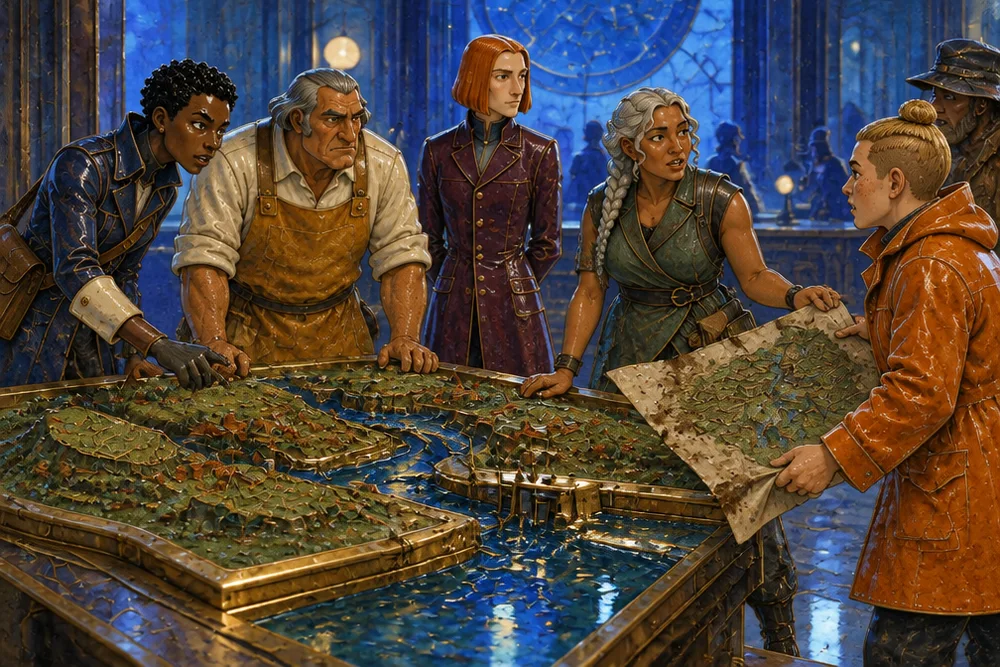
From the doorway came a scrape of boots and the smell of wet soil. Lowbank had sent its terrace keepers, three women and two men, their cuffs stained with the green-black mud of the spillway fields. Their spokesman, Orrel, carried a rolled survey of the lower banks. He unrolled it without greeting anyone. On the map, the lowest terraces were marked in brown ink and crossed by old flood lines.
“You want a new intake,” Orrel said. “Here is one. Lower terraces become overflow ground. When the pond backs up, it comes here instead of under our houses.” He looked at Sia. “We lose planting ground. We will not lose it without a claim we can enforce.”
Orrel’s map had been folded so often the creases had begun to split. Sia laid a paperweight on each corner. At the bottom, a series of small squares marked the terraces that Lowbank had built over generations, each square crossed by a different hand’s notation. Their owners had written names beside the plots, not just numbers.
“If those become overflow ground,” Sia said, “the claim needs to belong to the households, not to the village council. Otherwise the next council can decide the loss was already paid.”