The Province Inside the Compass
Page 203 of 212
Chapters
Then the fixed opening gave them a cream-colored stripe. It entered through the notch and spread across the dial, hard-edged and merciless. The nearest brass lines threw long shadows. The faces in the crowd appeared in pieces: the wet shine of Mara’s eyes, Iven’s pale cheek, Tern’s square jaw. It was the first exterior daylight the province had received without a hand holding the lid.
“Cover the cistern,” someone shouted.
“Don’t cover anything,” Iven replied. His voice cracked on the last word. “Not until the stores are counted.”
The shared emergency stores had been packed in sealed jars and dry bins beside the cistern, enough to sustain the villages through a failure in the first water cycle. Their arrangement was part of the charter: food and water under council seal, no village’s mark on the containers. A council member broke the seal with a hammer. The stamp fell in two pieces.
Sia heard clay scrape and lids come away. “How much?” she asked.
“Enough for the night,” Mara said. Her voice carried from the edge of the light. “Not enough for a season.”
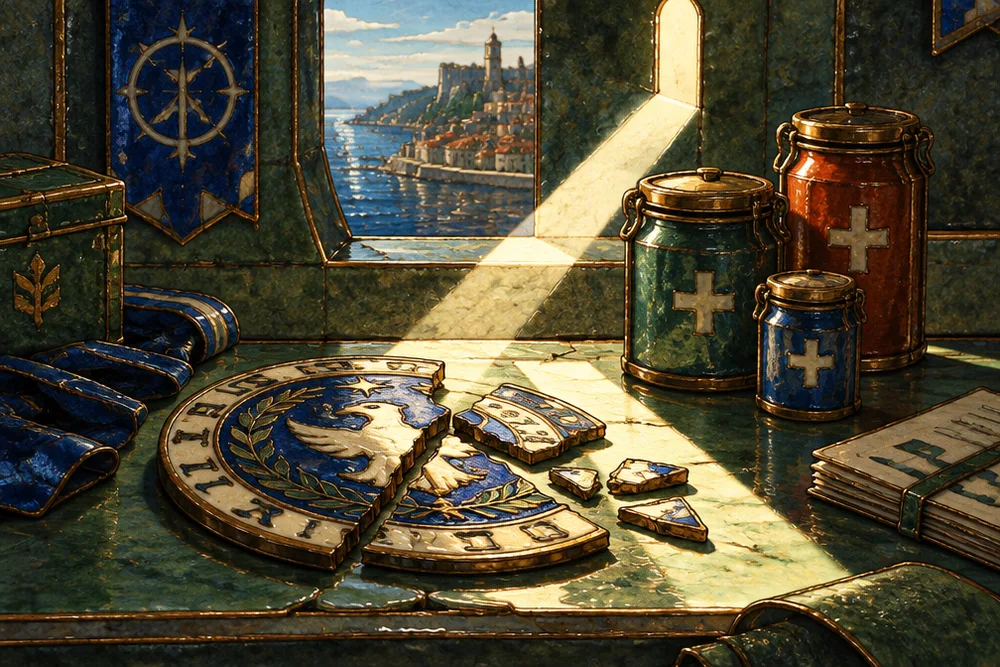
“We don’t need a season tonight,” Iven said. He had found the inventory sheet by touch and was holding it up to the opening’s thin illumination. “We need to get through the first cycle and see what the water does.”
A small vessel tipped as they began distributing the reserve. Someone caught it before it spilled. The care of that movement seemed to Sia more miraculous than the light: hands knew how to protect a thing even while frightened of what it meant.
She crouched beside the cistern. At its edge, the old blue radiance persisted as a memory in her eyes, then faded. The water was clear and dark. Above it, the notch remained open. Beyond the opening, an enormous blank brightness waited, with the pond and its far shore only partly visible.
“We can’t close it,” Tern said. He had not meant it as an accusation. He sounded as if he were reminding himself.
“No,” Sia said. “Not without destroying the passage we just made.”
They had known that. They had voted knowing it. Yet the words changed the darkness around them. A permanent opening was not an invitation they could withdraw from when the first cost arrived. It was a condition they had chosen to live inside.