The Postbox at the End of the Ice
Page 67 of 198
Chapters
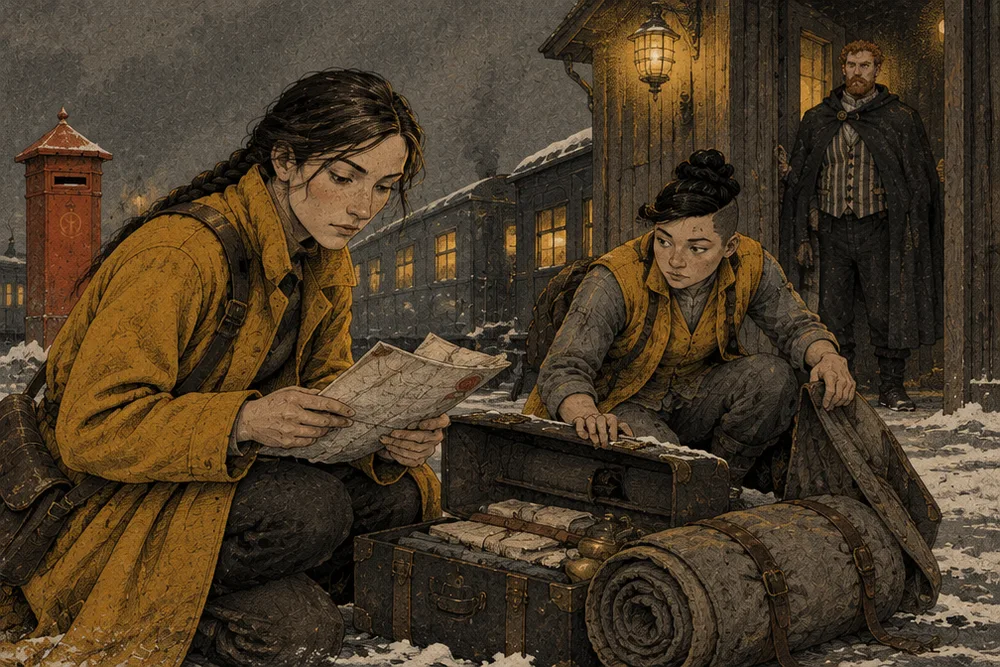
The field book lay open by her elbow. She wrote a new heading: “Purpose of red box, according to compact.” Then she paused before recording the rest. It mattered who said it. Ada had known the crossing from its working days. The document had outlasted the district’s maps. Mara wrote both facts down.
Tern took the compact only after Ada nodded. He leaned over it, one hand braced on the table, his dark coil of hair brushing the yellow collar of his overcoat. The printed lines were small, but the inked diagram at the foot of the page was plain enough: a cable running from the tongue to a landing east of the old road, with a cradle suspended between. At the outer end, a box marked DISPATCH. At the village end, a bell and a lever marked BRAKE.
“That’s the shelf we saw,” Tern said. “The roofed one above the tongue.”
“You’ve been there?” Mara asked.
“When I was little. My aunt kept nets on that side. She made us wait up there when the tide ran hard.” He traced the diagram’s eastern line in the air, careful not to touch the ink. “The entrance is still under the ridge lip. You can’t see it from the depot.”
“You knew it was a crossing?”
“I knew it was a place to stay dry. They told us the road was closed, so I thought the shelf had been abandoned with it.”
Ada nodded once. “People stopped saying what it was for. The names for things go first. Then the things themselves.”
Mara studied the diagram. Its scale did not match any map she carried, but the directions made sense of the land. The old road ran west, a broad track for freight sleds. The return landing lay diagonally east, across a narrow channel sheltered by the tongue. From the depot, the cable would be hidden by rock and low ground. The crossing had been built to serve people already on the outer side, not loads arriving from Wickhaven.
She thought of the red box’s mouth, the black slot under its rusted cap. She had nearly come at it from the wrong side, carrying a pulley as if the district’s road were the only line that mattered. The box had made no promise to the freight sled. It had simply remained where the first builders had put it.