The Postbox at the End of the Ice
Chapter 13 · Three Notes, Hold
Page 155 of 198
Chapters
The cradle came back empty, its runners whispering over the cable. At the Wickhaven landing, a yellow lamp lifted once, then steadied: the crew was ready. Mara watched it from the rock tongue while the wind worried at her coat and the tide shouldered dark water through the open lead. The first passenger had crossed. The second delivery had been accepted. Neither fact made the remaining people lighter, warmer, or fewer.
Behind her, the waiting shelf held a crowd in the narrow shelter of its roof. Blankets were wrapped around shoulders and knees; breath clouded in the lamplight. The injured man lay on a door panel borrowed from the depot, his leg splinted with two crate slats. His name was Orrel, Ada had told her. He had stopped shivering during the first crossing, which Mara had learned was not always good news. Ada crouched beside him, one white plait tucked under her scarf, keeping two fingers against his wrist.
The cradle could take three seated passengers if they were small, or two with room for the attendant to brace. Its cable ran east to the return landing, then back to the tongue through the fixed works. The pulley Mara had carried from Wickhaven now turned above them, battered rim catching a dull yellow gleam. Each crossing took time to haul and reset. The slack water was a window, not a promise. Beyond it, the current would gather beneath the ice edge and shove the cradle against whatever held it.
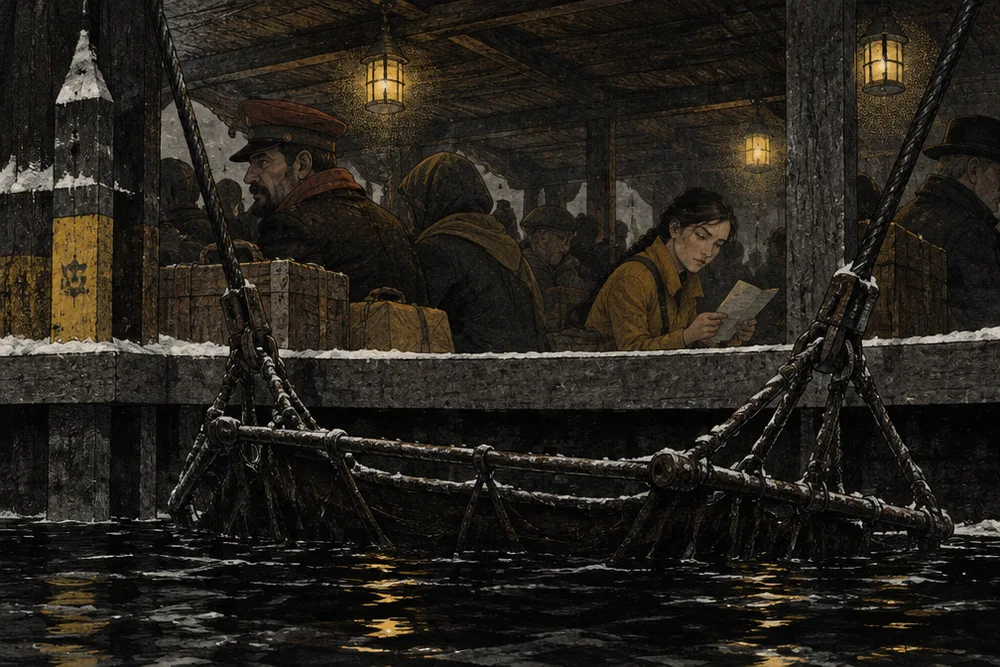
Mara had counted every name against the passenger roll. She had counted again after the first run, because a list could be correct and still leave somebody out. The people waiting now were no longer cargo in the district's columns. They were cold bodies with stiff hands, wet boots and names that had to reach the other shore intact.
She lifted her copy of the manifest, folded twice against the damp. “We go by exposure and ability to travel,” she said. Her voice came out hoarse but carried through the shelf. “Not by whose work was insured, or who can stand nearest the door.”
A murmur answered her. No one argued about the rule itself. They argued with their eyes, with the way a man shifted his numb feet so they would not be seen shaking, with the way a woman pulled her child closer beneath a blanket that had gone thin at the elbows.