The Postbox at the End of the Ice
Page 65 of 198
Chapters
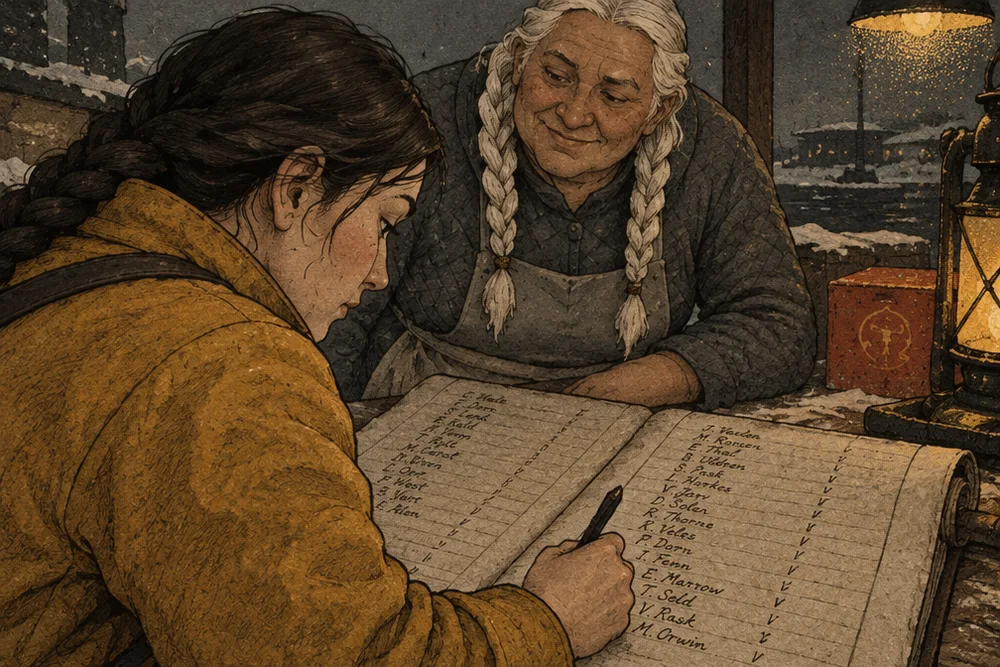
The roll began with a column for names and another for the landing where each person was to be taken. Its paper was cream-colored, its ink mostly black, though a few entries had been corrected in blue. At the top, someone had written a date from the present winter. Beneath it were the people now sheltering at the depot, listed in groups by household. More names appeared after them: residents at the outer houses, two who had gone to the ridge and not returned, and one whose mark was a small cross beside the words “unable to walk.”
Mara recognized several. She had carried parcels addressed to the Pell house and the Orret brothers. Here, in tidy lines, their names appeared not as recipients or senders but as passengers. Beside each was a note: child, elder, injured, requires assistance. The final column was headed “receiving shore acknowledgment.” It remained blank.
“This is current?” Mara asked.
“It was current when it was placed in the box,” Ada said. “I added the names we knew before the power failed. The two at the outlying houses are still missing from it.”
Tern leaned closer without touching the paper. “Then it’s no good as a final count.”
“No,” Mara said. “It’s a start.” She copied the names into her field book, preserving the cross and every note. The list was not a claim that those people had crossed, or even that they had all been found. It was an accounting of who might need a way home. That difference seemed more important than the blank lines.
Ada tapped the envelope’s broken edge. “The district asked for passenger names before it would staff the landing. We could not send them across on the road, and we could not get a boat in. So the list went where the instructions said it should go.”
“Inside the postbox,” Mara said.
“Where else?”
Mara looked up. “I thought the box was a delivery point. A place for freight that couldn’t go along the road.”
“That road came later.” Ada’s voice sharpened, not with anger at Mara but with the strain of carrying an explanation too long. “People built the crossing first. Before the district had a freight route. Before anyone drew that central track on a map. The box was part of the crossing.”
Tern shifted his weight. “The marks on the pulley. I thought they were distances.”
“They’re not,” Mara said. “They’re bell signals.”
“You said that on the sled,” Tern replied. “But you didn’t know who was meant to answer.”
Mara looked at the names in her book. The far side of each line was empty. “I’m starting to.”