The Postbox at the End of the Ice
Page 59 of 198
Chapters
Mara untied the string. It had been knotted with care, but the paper was brittle where the seal had pressed into it. She lifted one flap, then another. Inside lay a folded document wrapped in oilskin and a narrow roll of paper secured with blue thread. Ada watched the contents emerge without reaching for them. The first sheet bore the old postal mark and, beneath it, the name of the original crossing compact.
“This was meant to go to Wickhaven,” Ada said. “Not to stay with me.”
Mara laid the oilskin-wrapped document on the table and unfolded the narrow roll. It was a passenger list, the paper yellowed at the edges, with names written in two different inks. Some were crossed through. Beside each was a small mark: a household sign, a tally, or a note she could not immediately read.
“These are current?” she asked.
“The names are current,” Ada said. “The roll was copied last autumn. There are people on it who have been waiting for the crossing to reopen. Some can walk. Some can’t.”
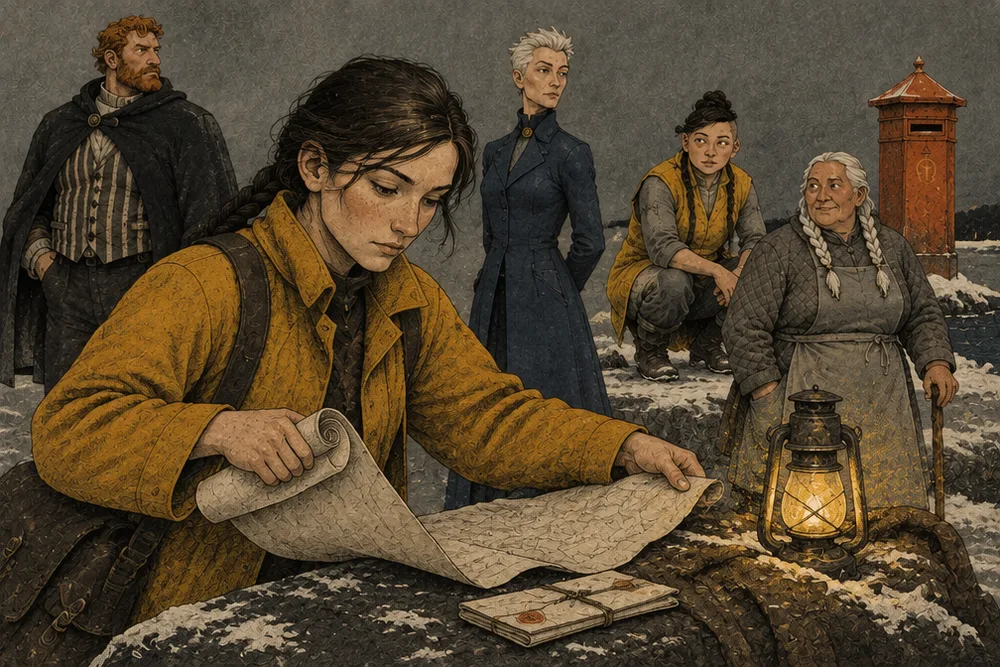
Mara ran her finger down the column. She recognized a family name from the depot slate, then another. Several names were unfamiliar. At the bottom, in a darker ink, was a line added later: passengers to be carried to Wickhaven when the landing is staffed. No freight before the people listed.
The compact beneath the roll was made of two pages, its corners protected by oilskin. Mara read the heading, then the first lines. Twenty-four winters earlier, Wickhaven and Alder Reach had agreed to build a passenger return crossing, with a waiting shelf on the outer-shore tongue and a cable to the inner landing. The red postbox was named as the point where a passenger or message could be registered for the journey home. The district had later built a freight road beside it, but the compact remained in force unless both shores released it.
She read the clause twice. The road was not the crossing. The road was what came after, a heavier route laid beside the older one. The red box had never been an endpoint in the sense the current map implied. It was the start of a return. It told the village where to send a traveler, and the outer shore where to answer.
Mara looked at the parcel’s tag. Wickhaven. The word was no longer merely an address. It was the half of the route that had been made to wait.
“Why didn’t the village know?” she asked.