The Postbox at the End of the Ice
Page 20 of 198
Chapters
“The order says deliver.”
“A road closed by the district is a refusal, not a destination.”
Sella’s gaze sharpened. “Do not confuse an obstacle with an instruction.”
“I don’t.”
Mara slid the copied entry into the parcel’s paper sleeve, then tied a strip of her own linen around the bundle to keep the old knot from loosening. Her hands moved in the patient sequence she used for damaged packages: support the weak corner, keep the label visible, never put a fastening over the address.
“You’ve decided, then,” Sella said.
“I’ve decided to take it as far as the sled can go.”
“That is not the same as delivering it.”
“No.”
“The order requires delivery.”
“Then the order can wait for me to reach the box.”
Sella studied her, the hooded eye steady and unreadable. “And if you cannot?”
“I’ll write down why.”
For a moment the postmistress seemed about to answer. Instead she straightened the parcel’s tag, aligning it with the fold in the paper. “You may take the order in its sleeve. The original stays here until the delivery is completed.”
“Agreed.”
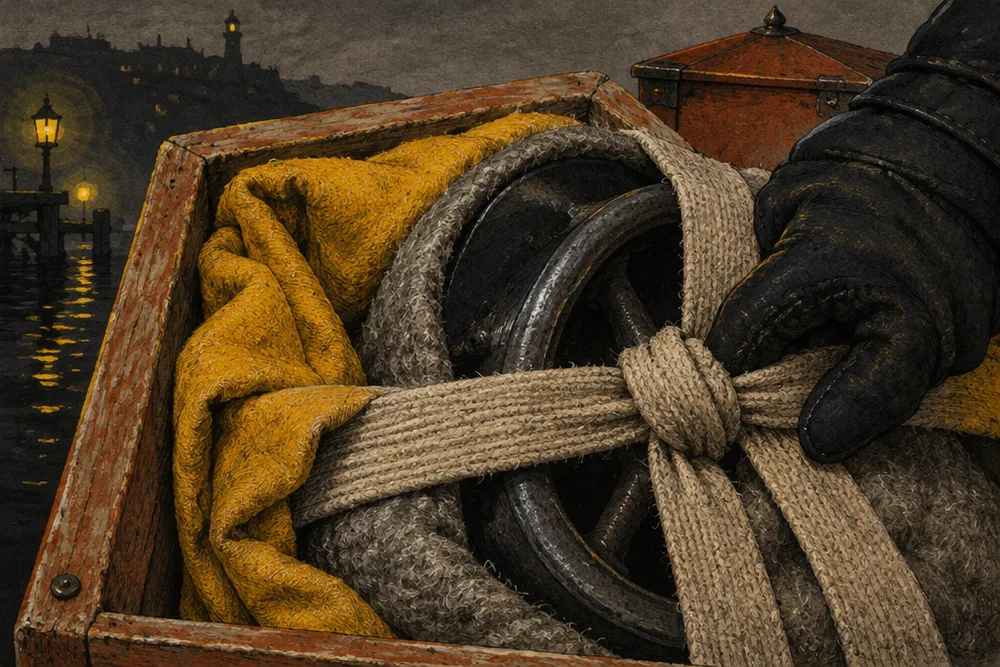
Mara carried the parcel to the back room, where a narrow shelf held the returns awaiting dispatch. She found a clean square of canvas and wrapped the parcel once, leaving the tag exposed. Her own satchel would be too soft; on the sled it needed a rigid support. She had a small wood case under her cot at home, used for fragile returns. The case had been built for a set of glass insulators, its corners reinforced with copper strips. It would fit the parcel with room enough for padding.
She went to fetch it while the post office settled into its night sounds. The stove ticked as it cooled. Sella sorted letters at the front desk. Mara passed the window and saw the quay lamps haloing in the snow, each flame surrounded by a trembling yellow haze. Beyond the lamps the harbor was a single dark sheet, the ice too new to bear anything heavier than windblown powder.
At home, she unlatched the wood case and tested its hinge. One corner had split where the last parcel’s contents had pressed against it. She fitted a strip of felt over the crack and braced it with a narrow board. The work was familiar. For years she had made boxes last longer than the goods they protected. There was pride in that, though no one paid extra for a parcel that arrived without breaking.