The Names Beneath the Needle
Page 47 of 222
Chapters
The new machine could keep each design on file. It could reproduce a name exactly, switch from one garment to the next without a pause, and count its own stitches. That was what Celia wanted from the sample run: a process that could be priced, checked, and repeated. Keziah had built her bid around speed and a clean spreadsheet. The drawer reminded her that a clean spreadsheet might describe only the part that was easiest to count.
She picked up a slip with a date from the previous year. A line of numbers had been written on the front, then crossed out. On the reverse, a name had been rewritten in larger letters, the pencil pressed so hard it had scored through to the front. Keziah could not tell whether the first version had been wrong, unwanted, or merely too long for the garment. She felt the urge to scan it, to preserve the ambiguity as an image and label it later.
The scanner sat beneath the counter, a small flatbed she used for receipts. She pulled it out by its plastic handle. “If I save the slips, I can at least keep the history. Strip the names from the file afterward. I could record dates and prices, maybe the kinds of changes people request—”
“Put that back.”
Quirina’s voice was low. It stopped Keziah’s hand before the scanner touched the paper.
“I’m not going to put the names in the file.”
“You can’t know what you’ll leave in.”
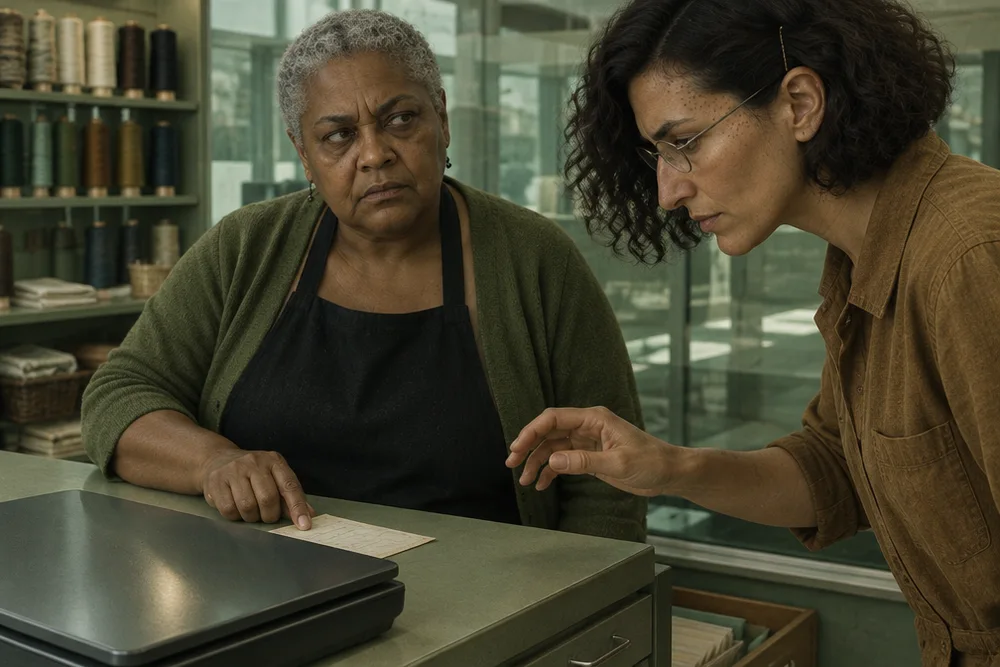
“I can crop the edges, delete the writing—”
“You don’t know what you’d be deleting.” Quirina came around the bench. At the counter, her short, solid figure blocked the scanner’s narrow reflection in the glass. Her face had gone still. “That paper doesn’t belong to the shop just because it was written here.”
“The invoices are shop records.”
“Some of them are. These aren’t all invoices.” She touched the edge of a slip with one thick finger, careful not to cover the pencil. “I kept them because I was afraid I’d forget an order. That doesn’t make them yours to copy.”
Keziah lowered the scanner onto the counter. Its lid clicked shut, empty. She felt the old defensive response rise—the need to explain that she was trying to do something useful, that she understood privacy, that information could be protected. She had been about to make the very same assumption she was asking the workers not to make: that her good reason settled the matter.
She drew her hand away. “I didn’t mean to use them against anybody.”