The Mountain Has an Appointment
Chapter 3 · First Fare in Twenty Years
Page 22 of 224
Chapters
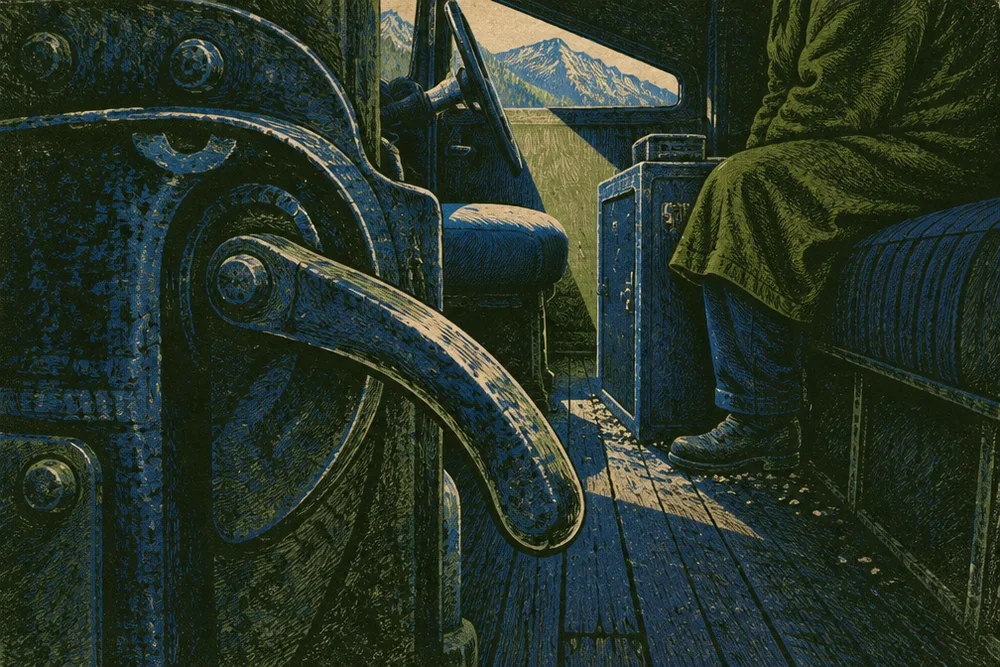
At 09:08, the car stood with its doors open and the mountain folded into it. The triangular window above Latch Shed laid a bright patch across the driver’s seat, but the light stopped short of the passenger bench. There the stranger sat hunched beneath its moss-colored coat, knees nearly level with the fare box. Grit sifted from its hem onto the cracked aisle slat.
Mara Valegrove kept one hand on the crescent brake handle. The other held the brass inspection key, still on its blue cord at her throat. She had checked the brake twice. The first time, she had listened. The second, she had let the mountain’s weight settle onto the car and listened again. The sound from the housing was low and even, without the scraping that meant a shoe had caught.
Iven Sedgemant stood outside the open doorway, one hand buried in his waistcoat cuff. A receipt corner showed between his fingers. His rounded shoulders made him look shorter than he was, but his voice carried cleanly into the car. “We empty the valley. Now. Every household gets uphill, no arguments, and we let the thaw take the market.”
“The road runs along the lower channel,” Mara said. She planted her feet wide before she spoke. “The first wave would cut it.”
“If we wait, it may cut everything.” Iven looked past her to the mountain. “There are people in town who don’t even know there’s a problem.”
“Then somebody has to tell them before we send water through their road.” Mara kept her voice level. She knew what he was asking: leave the car, leave the only route she understood, and trust an evacuation to be faster than a flood.
The mountain’s flat nose pointed toward the doorway. Its quartz-flecked lower lip parted. “The channel is not the only way the water can go,” it said. Its voice had the dry weight of stones rolling under ice. “But I must reach the stone beneath the freight terminus.”
Iven pulled the receipt from his cuff and flattened it against the doorframe. The paper had a crease down its middle and a thumb-smudge over the buyer’s mark. “Even if there’s another way, this car has no right to carry that load. The old anchors were built for passengers and freight, not a mountain.”
“They were founded on its own bedrock,” the mountain said. It did not lift its voice. “The slope bears me when I walk. The suspended car gives the weight to the anchors. That is why I came here.”