The Mountain Has an Appointment
Page 172 of 224
Chapters
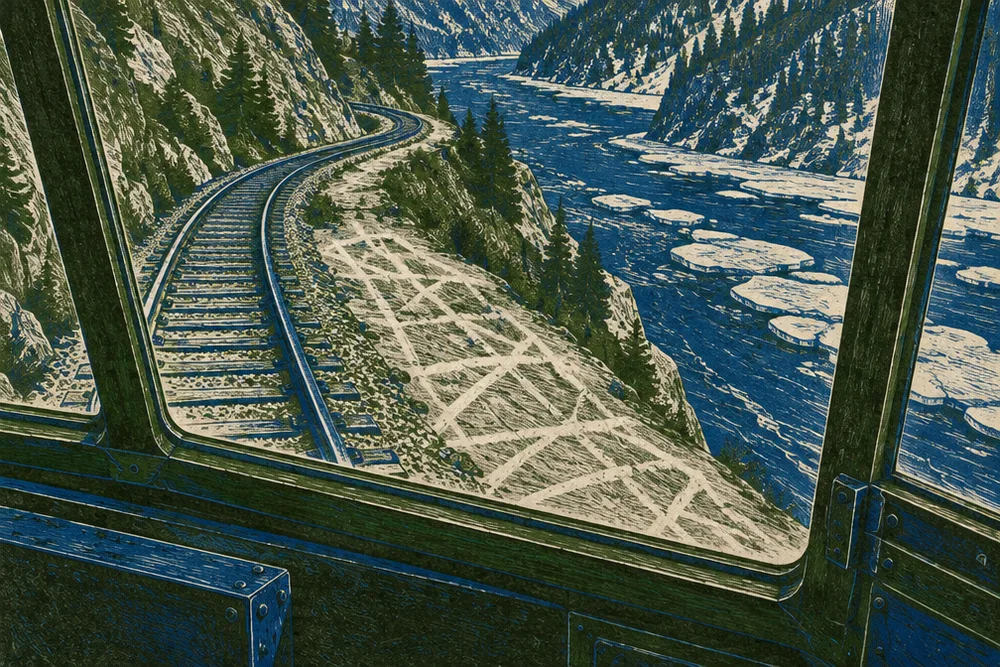
A wheel clicked over a joint in the rail. The car’s right side lifted a fraction, then came down. Through the front pane Mara saw the track bend away from the overlook. The curve tightened as it descended, turning the car’s nose toward the river and the shelf.
“Now,” she said.
The Mountain shifted its shoulder to the centerline. Its long forearms came down across its thighs. It had folded itself smaller to fit the car, but there was no way to make its mass small. The floorboards groaned beneath it. The frame held.
Mara eased the crescent back. The car continued downhill. She kept the brake between them and the speed the cable wanted, feeling the difference in every inch of handle. Above the window, the upper track vanished behind a shoulder of dark rock. Ahead, the shelf remained visible, still marked with Calder’s chalk.
The turn began gently. Mara knew the angle from the survey and from the pressure in the rail, which reached the car through its wheels as a faint sideways tug. The curve had been built for freight, for bundles of timber and crates that could be tied down and dropped without complaint. The passenger car had five panes on either side and a narrow aisle; it had never been designed to be a crate.
“Keep your weight there,” Mara said.
“I am.”
“More centered.”
The Mountain adjusted by inches. The car gave a lurch that traveled from the rear wheels to the front. A jar somewhere in the gear compartment rattled against its chain. Mara counted the beats between wheel joints, keeping her attention on the brake and the line ahead. Her shoulders burned from holding steady. She did not look down for long.
The market was behind them now. In the glass, it showed as a scatter of roofs and awnings. The bell tower stood over Silt Market, its iron mouth still. Below it the flood channel ran open through the Blue Rag Yard, a dark cut between pale stones. The yard had been built over the old outfall in the belief that the mountain’s winter drainage would continue as it always had. The lake had been filling behind the ice for months.
If the Mountain reached Heelstone before noon, the water would take the outlet instead of the market. If it did not, the thaw would do what the buried channel had once prevented. The people below had moved beds, jars, looms, racks, and all the pieces of their lives they could reach. The buildings would still be there, but the water would choose its own route through them.