The Moon That Owed Us Rain
Page 92 of 212
Chapters
She entered the request, the refusal to promise, and Orri’s condition that the readings remain public. Her hand cramped around the pencil. She loosened her grip and continued. Each sentence made the record harder to dismiss as a mistake made by one person in one room.
Before evening, she had a provisional queue. It ranked settlements by hours of water remaining for essential use, adjusted by confidence in the reading and the number of people depending on each tank. The list kept Reedstep near the front, but not automatically first; Mallow Bend’s uncertain intake could move it ahead if its keeper confirmed the leak. Siltcross remained unranked pending a direct reading. Hushbank needed a beacon relay before any delivery could reach it.
Istra wrote PROVISIONAL across the top. Beneath it she listed the rules: no charter precedence; no private guarantee; readings open to keepers and city; emergency shares not resold; disputed measurements marked, not erased. At the bottom she left space for corrections. It was an ungainly list, but it could change when the facts changed.
Orri read it in silence. His finger stopped at the line about no charter precedence. “The city will object.”
“The city can object in public.”
“And if it refuses the route?”
“Then we’ll know before the storm crossing. We’ll have to find another route.”
“You say that like there’s always another.”
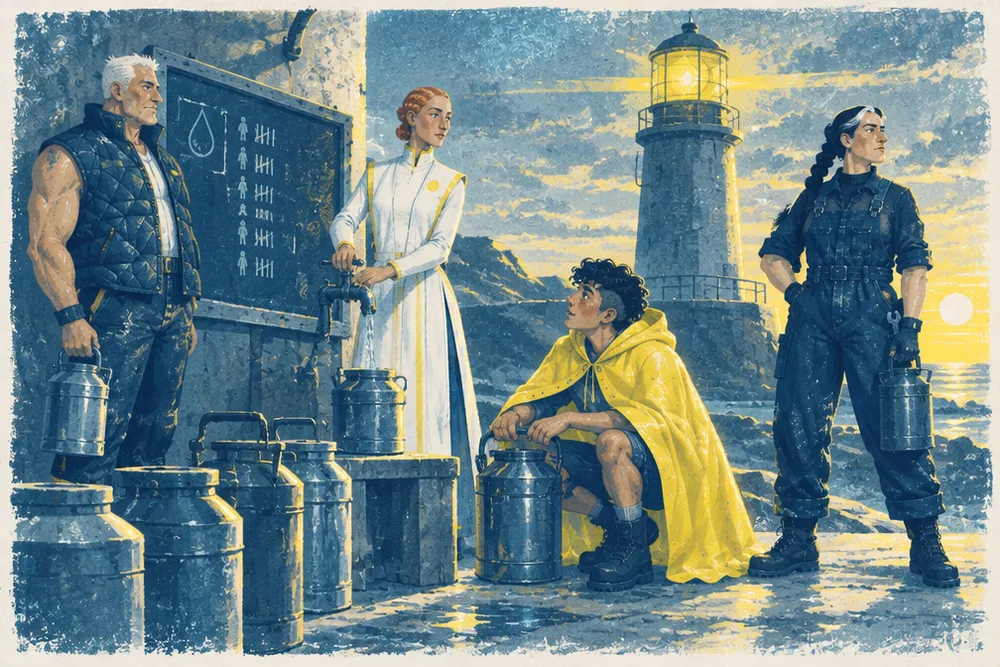
Istra thought of the rising water, of the pressure gauges shivering under her fingers, of the valve she had not yet dared to open beyond a measured pulse. “There may not be. I won’t pretend there is.”
He gave the paper back. “The readings stay open. No guarantee. No resale.”
“I’ll put your terms in the request.”
“Don’t put my name on a thing I haven’t agreed to.”
“I won’t.” She amended the entry: conditions offered by Reedstep’s keeper, pending consent from other villages. Then she copied the list onto a fresh sheet, leaving the rough notes attached behind it. A clean version without its working would look like certainty. She wanted the doubts visible.
Outside, the landing beacon’s lens caught the lowering sun. It did not turn. The old line was waiting for a call, and somewhere beyond the ridge the city’s collector held the authority to answer first. Istra rolled up the queue with the figures facing outward and tied it with a strip of wire.
It was not an order of delivery yet. It was a provisional order of need, measured in hours rather than charter years. She sent the routing request to Sella and carried the original to Orri’s board, where the villages absent from the city map could see their names in ink.