The Moon That Owed Us Rain
Chapter 6 · A Crack in Grease Pencil
Page 47 of 212
Chapters
The test shaft was empty because Tem had made it empty twice. First he walked the gallery himself, touching each doorframe with the back of his knuckles and calling the names of the households that had used the passage. Then he sent two residents through with lemon lamps, one to each branch, to check for stragglers and sleeping children. They returned carrying a tin kettle and a bundle of damp shirts. The kettle had been left on a sill; the shirts belonged to a family now waiting in the dock with the rest.
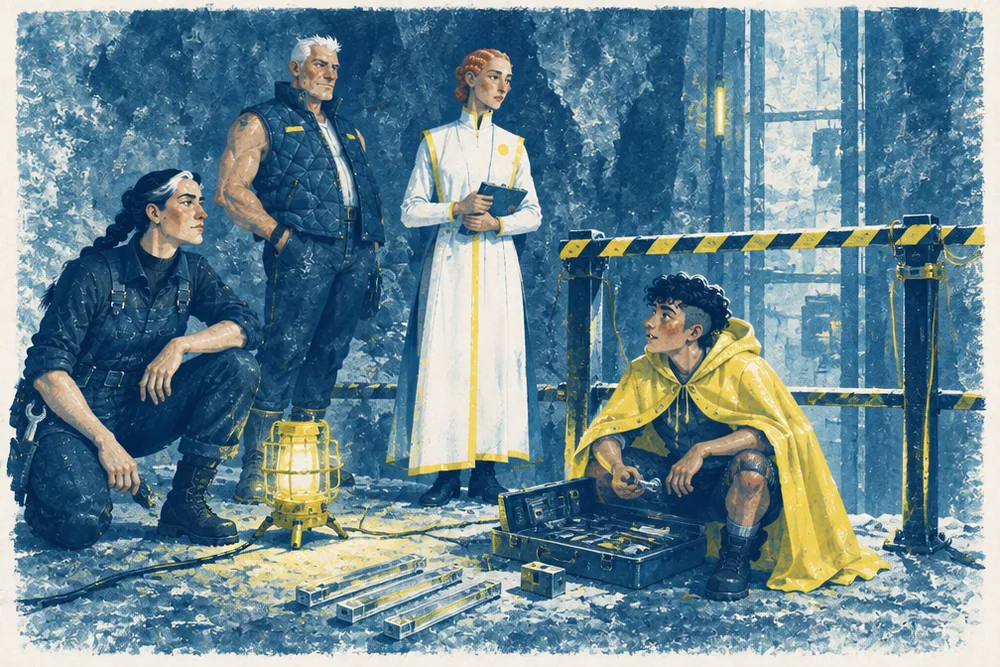
“No one below the yellow cord,” Tem said. He leaned back on his heels, silver brush cut bright beneath the lemon lamp. “And no one above it until we say.”
The shaft dropped through Latch’s inhabited shell toward the old return pipes. Its walls were a salt-grained blue, the paint scuffed pale at shoulder height where generations had squeezed past with water jars. Istra studied the hairline gauges she had mounted across the nearest seam. Each was a narrow glass tongue fixed to the wall at both ends, with a dark line painted through its center. A shift of the wall would break the line. Her own kit lay open beside her: spanners, a hand pump, two pressure needles, and the small brass valve key she had carried from the dock.
Beyond the cord, a resident watched from the gallery mouth, arms folded. Istra recognized her as one of the women who had brought the shirts. No one asked whether this was safe. They had already learned that a mechanic’s confidence could be another instrument, one that gave a false reading if nobody checked it.
“We need a measured test,” Istra said. “Not a release. The shaft stays empty. If a gauge moves, we close the valve.”
Tem looked at the needle, not at her. “And if the first drop makes a crack?”
“Then the first drop is the answer.” She heard how neat that sounded and wished she could take the sentence apart. “We stop. We shore the seam. No second test until we know what moved.”
Tem bent his triangular face toward the glass, split lower lip set in a patient line. “You’re not testing whether water can come through. You’re testing how much the shell can forgive.”
Istra tightened the clamp on the nearest gauge. “Yes.”
They had made a catch basin from an old laundry trough and set it beneath the outlet. Its enamel was chipped down to metal in three places. Tem had insisted on measuring the basin first, then filling it to a mark with water hauled from the dock stores. The water was drained away again, leaving only a dark wet line inside. A second basin, dry and clean, waited beside it for comparison.