The Moon That Owed Us Rain
Page 65 of 212
Chapters
Istra glanced at Tem. He had heard every word. “I won’t.”
The channel clicked off. She set the handset down and wrote the authorization number across the top of her survey sheet. Beneath it she added: REEDSTEP BEACON—RESPONSE UNVERIFIED. The phrasing felt cautious, and caution was warranted. But for the first time since the tracer had disappeared into Ninewells’ trunk, the route ahead did not end at the city collector.
Tem lifted his quilted coat from the bench. “We’ll need the old receiver diagram.”
“And a way to reach the beacon.” Istra tucked the chart into her case. “Let’s see whether Reedstep still has a voice.”
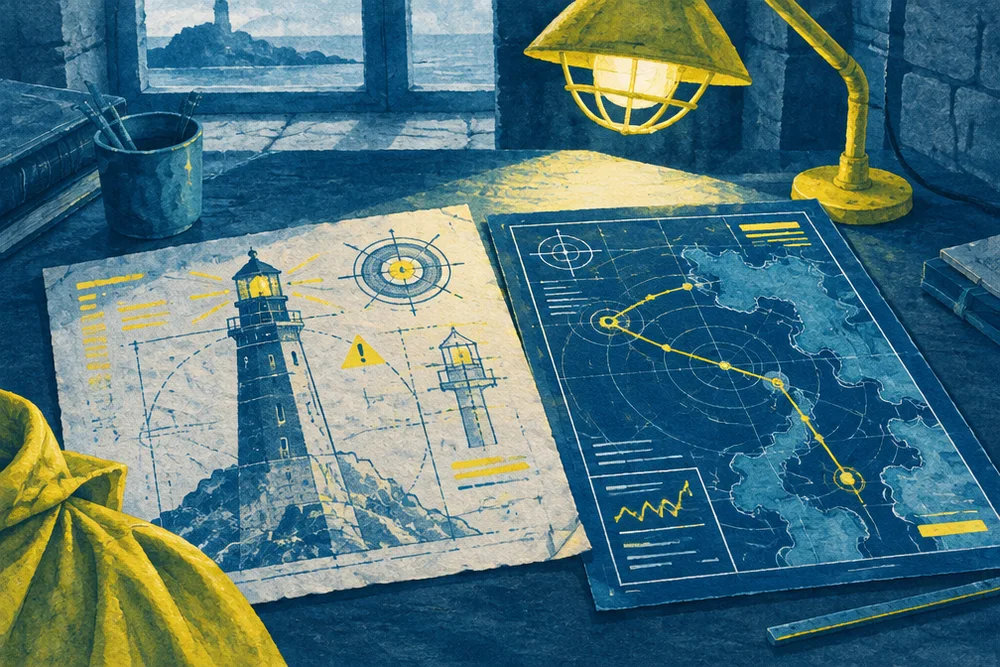
The old receiver diagram was stored in a cabinet outside the machine rooms, under a drawer marked obsolete controls. Istra found it between a cracked pressure wheel and a stack of service tags whose ink had faded to gray. The paper was brittle at its folds, but the symbols matched the terminals at the hatch: a ring, three strokes, and a small arrow pointing toward the ground.
Tem stood over her shoulder as she opened the sheet. “That’s the beacon call,” he said. “One long signal to wake it, then short acknowledgments. The receiver returns a pulse if the gate is listening.”
“And the gate?”
“Depends on the village. Some had cistern shutters. Some had a spillway that could be set by hand.”
“That’s not much of a standard.”
“It was enough to bring a landing craft down in fog.”
Istra traced the connections with a pencil. The old network had no central controller. Its calls moved from one receiver to another along a line of relay posts, each with a local identifier. The map showed a chain of names, some familiar from the current water ledger and some absent. Reedstep sat near the lower edge, marked with a square beacon and an open-circle cistern.
There was no notation for Ninewells. The city’s collector had been added later, threaded into the original trunk at a junction where the village relay line once branched. The drawing did not show a physical disconnection. It showed a cable severed at the joint and tied back with a loop, an alteration small enough to be missed by a clerk and large enough to change the fate of every drop.
Istra set the diagram beside the tracer chart. “The collector didn’t replace the old system. It captured its trunk.”
Tem’s eyes narrowed. “Can we isolate it?”
“Not from the machine room. But a dry signal might reach a receiver on the far side of the cut. If it does, we’ll know the local circuit is alive.”